Travel

Breaking Ground The Inaugural Sustainable Transatlantic Flight - Pioneering Aviation's Environmental Shift

Breaking Ground: The Inaugural Sustainable Transatlantic Flight – Pioneering Aviation’s Environmental Shift

In a defining moment for the aviation industry, the inaugural sustainable transatlantic flight, VS100, has broken ground in pursuing eco-friendly air travel. Departing from London’s Heathrow Airport on November 28, 2023, this historic journey marked the first-ever transatlantic flight powered entirely by sustainable aviation fuel (SAF). The flight, operated by Virgin Atlantic and bolstered by UK government support, has ignited celebration and scrutiny across various spheres. A bold ambition lies at the heart of this groundbreaking flight: reducing net carbon emissions. Aviation, long criticized for its substantial environmental impact, faces a pivotal question: Could this pioneering flight hold the key to mitigating the industry’s environmental challenges? Traditionally, airlines have experimented with blends of up to 50% alternative fuels, termed SAF, but the VS100 flight stands out, using fuel derived predominantly from grease and other waste products. Its mission? To showcase a tangible path towards significantly slashing net carbon emissions associated with commercial flights. The significance of this feat hasn’t gone unnoticed. Mark Harper, UK Transport Secretary, who was on board the flight, emphasized its importance, envisioning a future where transportation undergoes a radical decarbonization, with a staggering 70% reduction in lifecycle emissions. Chancellor Rishi Sunak echoed these sentiments, recognizing the flight as a pivotal stride toward greener air travel and the crucial decarbonization of our skies. Such sentiments underscore the UK government’s commitment to the ‘jet zero’ objective—a concerted effort to minimize carbon emissions linked to aviation. Yet, alongside accolades, the journey towards sustainable aviation encounters substantial challenges. While Virgin Atlantic champions the safety and efficacy of SAF as a viable alternative to conventional kerosene, Sir Richard Branson, the airline’s founder, echoed a sentiment throughout history: ‘The world will always assume something cannot be done until you do it.’ Central to this initiative is using SAF, which airlines consider pivotal to curb net emissions. However, the current availability of such fuel remains relatively low compared to the global consumption of kerosene, posing a significant hurdle to widespread adoption. Shai Weiss, CEO of Virgin Atlantic, stressed the imperative of radical collaboration while acknowledging the stark reality: the inadequacy of current SAF production. To achieve large-scale viability, substantial investments must be made. Recognizing the pivotal role of sustainable aviation in the future landscape, the UK government has pledged ongoing support to the SAF industry. Efforts for job creation, economic growth, and the ambitious’ jet zero’ goal have been underscored. Plans to construct five SAF-dedicated plants by 2025 in the UK illustrate this commitment, despite the imported nature of the fuel used in the pioneering flight from the US and the EU. However, amidst industry and government commendations, environmental advocates remain skeptical. Critics highlight misleading assertions, especially regarding the Department of Transport’s claim that SAF will render guilt-free flying a reality. While the VS100 flight marks a crucial milestone in sustainable aviation, it also serves as a poignant reminder of the considerable challenges ahead. The road to widespread adoption of sustainable aviation fuel demands innovation and unprecedented collaboration and investment. As industry pioneers forge ahead, the balance between aspirations and realities will shape the future of eco-friendly aviation. Sources: Virgin.com, The Guardian, Gov.uk, Stakeholders.com Related Articles:

Breaking Ground: The Inaugural Sustainable Transatlantic Flight – Pioneering Aviation’s Environmental Shift Read More »

Catching the Wave of Sustainability Balancing Climate Impact in the Surf Industry

Catching the Wave of Sustainability: Balancing Climate Impact in the Surf Industry

Climate change is emerging as a significant global concern, and its effects are felt in various industries, including surfing. This exciting activity, which has become a way of life for many people, faces significant challenges due to environmental impacts and climate variations. Oceanic Impact: Climate Regulation, Carbon Absorption, and Disturbing Trends These impacts significantly affect the oceans, which play a crucial role as climate regulators by absorbing heat and carbon dioxide. The oceans are essential to the climate balance, as they can capture about half of the carbon released into the atmosphere, making them the leading carbon sinks. Moreover, according to research published in Geophysical Research Letters, the oceans have absorbed more than 93% of the heat generated by human activities since the 1950s. This capacity of the oceans to absorb carbon dioxide plays a fundamental role in mitigating climate change. However, climate change is causing harmful alterations such as temperature increases, rising sea levels, and acidification. According to U.S. National Oceanic and Atmospheric Administration data, the oceans have recorded a record high temperature, reaching 21.1°C (70°F). This represents the highest seawater temperature in at least the last four and a half decades. According to the information presented, more than 90% of the increase in temperature is attributed to the rise of greenhouse gases in the atmosphere, resulting from activities such as the burning of fossil fuels and deforestation. Rising Seas, Surfing Sustainability, and Climate-Conscious Solutions On the other hand, according to the United Nations, the rise in sea levels in the oceans has accelerated in recent decades due to the increase in melting ice in the planet’s polar areas. The most recent data from the World Meteorological Organization show that the global average sea level has reached a new historical maximum in 2021, with an average increase of 4.5 millimeters per year from 2013 to 2021. In addition, this growth has resulted in a gradual loss of wave quality at many famous surfing beaches. Coastal erosion and changes in wave patterns have impacted the regularity and formation of waves suitable for surfing, thus threatening the sustainability of surf schools and local surfing businesses. Historically, the surf industry has been heavily tied to petroleum-derived materials, such as the polyurethane foam used to manufacture surfboards. The production process of these materials contributes significantly to greenhouse gas emissions and environmental pollution. As climate change worsens, there is an urgent need to look for more sustainable and environmentally friendly materials to reduce the environmental impact of this industry. Surf Industry Growth Amidst Climate Challenges Currently, the surf industry generates a total of US$4 billion, with an annual growth rate of 4%, and will reach US$5 billion between 2027 and 2028, according to a market study by ReportLinker. However, the increased frequency and severity of extreme weather events, such as storms and hurricanes, impact the production and distribution of surfboards. Numerous organizations associated with the surfboard manufacturing value chain have been experiencing damage related to climate change, causing delays in production, which has affected the supply of equipment to surfers and has led to an increase in production and transportation costs and, consequently, the final selling price to athletes. Fortunately, increased awareness of implementing more sustainable and environmentally friendly practices has increased the use of alternative materials in surfboard production. For example, some companies have used biodegradable and recycled materials and foams made from natural elements. These initiatives reduce the carbon footprint and improve the performance and durability of the equipment. Sustainable Innovations and Initiatives in the Surf Industry An example of best practice in the surf industry is “Smart Wax,” a product developed by the Clean Ocean Foundation. It uses a natural substance to neutralize harmful acids and transform them into pure water. This innovative product can be used in any surf wax formula. With this new product, the Clean Ocean Foundation urges surf wax brands to incorporate the use of Calcium Carbonate in their products in exchange for gradually contributing to neutralizing the increase of acidity in the ocean because of climate change. Another example is the innovative project led by a group of biology and chemistry students at the University of San Diego, collaborating with Arctic Foam, the largest board manufacturer in the United States, where polyurethane was replaced with a more environmentally friendly alternative. Through a chemical transformation of algae oil, they obtained various polyols that expand and solidify, creating a substance similar to polyurethane foam that can float on water. Speaking of good practices related to the surf industry, it is also important to highlight an innovative and sustainable example of the primary input surfers use to care for their skin, in which Avasol stands out. This company has created sunscreens based on natural medicinal and ethnopharmacology, offering them in biobased and refillable packaging to reduce the waste load on the earth. Voices and Actions in the Surf Community According to Emma Danzo, Avasol Manager for Marketing, Partnerships, and Social Media – “It’s easy to overlook the individual effects of the materials we introduce into the ocean through our surfing equipment, but together they have a large impact, and it’s up to us to turn the tide on the cumulative effect of our actions in the ocean. With Avasol, there’s no need to sacrifice sustainability for sun protection. As waterpeople, it’s our duty and privilege to protect that which gives us so much life and love.“ It is also essential to mention Olas Surf School Peru, with more than 31 years of experience in the surfing industry, has been developing strategies to position itself as the first surf school to promote climate and environmental awareness through the carbon-neutral certification of its operations. Roberto Meza, Director of the Olas Peru Surf School, tells us that Olas Peru has been developing educational programs for beach protection and environmental conservation through activations such as beach cleanups along the coast, acquisition of ecological garbage cans, as well as participating directly in the work plan for the approval of the law for the

Catching the Wave of Sustainability: Balancing Climate Impact in the Surf Industry Read More »

Lima Airport Partners Leads the Way in Sustainable Aviation Recognized at ACI-LAC Annual Assembly 2023

Lima Airport Partners Leads the Way in Sustainable Aviation: Recognized at ACI-LAC Annual Assembly 2023

The recent ACI-LAC Annual Assembly, Conference & Exhibition 2023 held in Miami showcased the dedication of Latin American and Caribbean airports towards pioneering projects in the aviation industry. The spotlight was on two critical areas – decarbonization and enhancing the passenger experience. Among the standouts was Lima Airport Partners (LAP), whose innovative project, “Sustainable Management of Waste and Materials in the New Jorge Chávez Expansion Project,” earned them the prestigious Green Airport Recognition 2023. Green Airport Recognition 2023 The Green Airport Recognition program is designed to spotlight and promote environmentally sustainable initiatives by airports in the Latin American and Caribbean region. Covering a range of aspects like waste management, energy efficiency, carbon emissions management, and climate change adaptation, this year’s edition was backed by TAV Technologies, a key technology provider in the airport market. Lima Airport Partners was among the fourteen distinguished airport operators recognized for their commitment to sustainable practices. LAP’s winning project, focusing on the sustainable management of waste and materials in the expansion of the Jorge Chávez Airport in Lima, Peru, was a standout example of their dedication to eco-friendly airport development. A Winning Project The “Sustainable Management of Waste and Materials in the New Jorge Chávez Expansion Project” is a testament to Lima Airport Partners’ commitment to setting new standards in airport sustainability. As a new airport city takes shape, LAP is determined to build a future that adheres to the highest national and international socio-environmental standards. This project not only reflects LAP’s dedication to environmental stewardship but also marks a pivotal step towards a sustainable and resilient future. ESG Award 2023 and ACI-LAC Green Airport Award 2023 In addition to the Green Airport Recognition, Lima Airport Partners was also honored with the ESG Award 2023, showcasing their commitment to Environmental, Social, and Governance (ESG) principles. These accolades serve as powerful motivators for LAP, reinforcing their dedication to the development of the new Jorge Chávez Airport with the highest standards and a positive impact on both people and the environment. WorldXChange – A Beacon of Sustainable Innovation Within the Jorge Chávez Airport, LAP’s commitment to green initiatives extends beyond the airport expansion project. A notable example is WorldXChange, a currency exchange office that holds both Carbon Neutral and Forest Friends certifications. Through actively managing and compensating its greenhouse gas emissions, WorldXChange goes a step further by supporting ecosystem restoration in Peru, showcasing LAP’s dedication to not only carbon neutrality, but also to contributing to the restoration of local fauna and flora. Conclusion Lima Airport Partners’ success at the ACI-LAC Annual Assembly 2023 exemplifies the pivotal role airports play in driving sustainable practices within the aviation industry. LAP’s dedication to eco-friendly initiatives, as demonstrated by their winning project and the recognition from industry awards, positions them as a leader in sustainable airport development. As the aviation sector continues to grapple with environmental challenges, LAP’s achievements serve as an inspiring model for other airports in the region and around the world, illustrating that a commitment to sustainability can lead to both operational excellence and positive impacts on the environment To contact us click here.

Lima Airport Partners Leads the Way in Sustainable Aviation: Recognized at ACI-LAC Annual Assembly 2023 Read More »

Limatours Tourism in Peru and Carbon Neutrality in Action - LimaTours Sets a New Standard for Sustainable Tourism in Peru

LimaTours Sets a New Standard for Sustainable Tourism in Peru

Tourism in Peru and Carbon Neutrality in Action With its tremendous growth and global reach, the tourism industry has become a significant contributor to carbon emissions and environmental degradation. As the world grapples with the pressing challenges of climate change, tourism operations must embrace sustainable practices and take the lead in mitigating their impact. LimaTours, a prominent Peruvian tour operator, has emerged as a trailblazer in this endeavor by becoming Peru’s first Carbon Neutral tourism operator and one of the pioneers worldwide. Their commitment to climate action, as embodied by their participation in the Glasgow Declaration for Tourism and Climate Action, is a testament to their dedication to supporting the goals of the Climate Paris Agreement. Recognized by the United Nations Framework Convention on Climate Change (UNFCCC) and certified by Green Initiative, LimaTours is now poised to transform the industry by decarbonizing its value chain and offering innovative carbon-neutral tourism services. The Urgent Need for Climate Action in Tourism The tourism industry’s rapid growth has come at a cost to the environment. The carbon footprint of transportation, accommodation, and various tourism-related activities has contributed significantly to greenhouse gas emissions. With climate change posing unprecedented risks to natural and cultural heritage sites, biodiversity, and local communities, the tourism sector must positively collaborate and act urgently to reduce its climate impact. The industry can play a vital role in mitigating climate change and safeguarding destinations for future generations by introducing climate action measures, such as carbon neutrality. LimaTours: Pioneering Climate Action in Tourism LimaTours, a renowned tour operator deeply rooted in Peruvian hospitality, has emerged as a leading force in sustainable tourism. Their recognition as Peru’s first Carbon Neutral tourism operator and one of the global pioneers highlights their unwavering commitment to sustainability and climate responsibility. By actively participating in the Glasgow Declaration for Tourism and Climate Action, LimaTours has joined hands with other industry stakeholders to address the urgent need to mitigate the tourism industry’s carbon footprint. Leading the Charge with Carbon Neutrality LimaTours’ achievement of being certified as the first Carbon Neutral tourism operator in Peru is a significant milestone in the industry’s journey toward sustainability. Recognized by the UNFCCC and certified by Green Initiative, LimaTours has become a shining example for other tourism operators. LimaTours has engaged in a solid carbon footprint management process by measuring, reducing, and offsetting its carbon emissions, internalizing climate action at the DNA of its business model. This milestone catalyzes change, promoting innovation in LimaTourism services and efficiency in their overall tourism operations. Decarbonizing the Value Chain LimaTours understands that true sustainability extends beyond achieving carbon neutrality. They are committed to decarbonizing their entire value chain by implementing innovative practices that reduce emissions at every stage of their operations. By addressing transportation, accommodation, and activities, LimaTours aims to minimize its carbon footprint while ensuring exceptional experiences for its customers. Through collaboration with partners and suppliers, they are driving the adoption of climate-smart practices throughout the tourism ecosystem. LimaTours climate action proposition focuses on reducing its carbon emissions and providing innovative, carbon-neutral tourism services. They are on the way to revolutionizing the industry by introducing climate-friendly initiatives and offering unique experiences that prioritize carbon-neutral tourism. From eco-lodges powered by renewable energy to carefully curated tours promoting local culture and conservation, LimaTours is reshaping how travelers explore Peru. Are you looking for support to achieve Carbon Neutrality for your tourism business? Look no further! The Green Initiative team is here to help you on your sustainability journey. Our dedicated experts are committed to assisting companies like yours in reducing carbon emissions and working towards achieving Carbon Neutrality. With our extensive knowledge and experience in green initiatives, we provide customized solutions tailored to your specific needs. Whether you need guidance on measuring your carbon footprint, implementing energy-efficient practices, or exploring renewable energy options, our team will work closely with you to develop a comprehensive plan. By partnering with the Green Initiative team, you will gain access to a network of sustainability experts, industry best practices, and cutting-edge technologies. Our team will provide ongoing support, monitoring progress, and offering guidance to ensure your journey towards Carbon Neutrality is successful. Together, let’s make a positive impact on the environment and demonstrate your commitment to sustainability. Contact us today to learn more about how the Green Initiative team can support your company on its path to achieving Carbon Neutrality. Contact us here today!

LimaTours Sets a New Standard for Sustainable Tourism in Peru Read More »

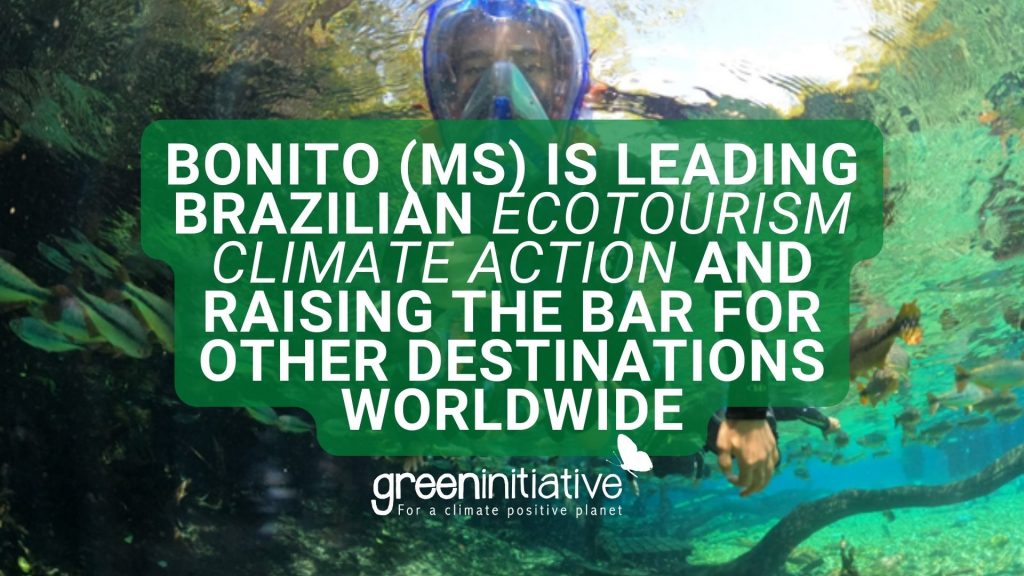
Bonito (MS) is Leading Brazilian ecotourism Climate Action and raising the bar for other destinations worldwide

Bonito: How a Brazilian ecotourism destination is leading climate action by example

As the world recovers from the shock of the COVID-19 pandemic, rebuilding a more sustainable tourism sector remains a shared responsibility of tourism firms and destinations. Amid mounting evidence of severe climate change, points that the window of opportunity to rapidly reduce greenhouse gas (GHG) emissions and avoid a climate disaster is rapidly narrowing. Atmospheric temperatures have already increased by about 1⁰ Celsius from preindustrial levels, and keeping that increase to less than 1.5⁰ through 2050 will require intense efforts by the public and private sectors. At the COP26 conference in November 2021, the UN World Tourism Organization (UNWTO), the United Nations Environment Program (UNEP) and their partners issued the Glasgow Declaration for Tourism and Climate, which calls on all tourism stakeholders to demonstrate a shared commitment to mitigating greenhouse gas (GHG) emissions by integrating climate action into the core of tourism business models and management tools. Brazil’s ecotourism industry relies on landscapes with extraordinary biodiversity and vibrant ecosystems that provide food and shelter for native species. One of Brazil’s key ecotourism centers is Bonito, a fantastic destination in Mato Grosso do Sul that rests atop the Guarani Aquifer, the second largest source of freshwater on earth. Bonito’s efforts to achieve carbon-neutral certification are based on over two decades of implementing sustainable tourism management practices. As early as 1995, Bonito created a Tourism Voucher system that is designed to control the number of tourists per attraction based on a scientific reference point for tourist capacity, and Bonito has since emerged as one of the most lauded ecotourism destinations in the country. After Bonito received the WTN Global Responsible Tourism Award in 2013 (London), government authorities launched a public-private destination governance body – FUNDTUR, which plays a key role in promoting sustainable tourism development best practices for Bonito. The carbon neutral certification process led by Green Initiative, was initiated with the signing of the Glasgow Declaration by FUNDTUR, in coordination with the Bonito municipal government and the state secretariats for the environment, tourism, and economic development. The carbon-neutral certification cycle requires an accurate assessment of the destination’s carbon footprint. This footprint establishes the baseline for reducing Bonito’s carbon emissions, which will need to fall by 45% by 2030 and reach net zero by 2050, in accordance with the guidelines of the Paris Agreement. The certification process also includes an assessment of the GHG capture and storage capacity of local forests, which include eight of Bonito’s main ecotourism attractions spread over 5,000 hectares. According to the carbon-footprint assessment, the main GHG emission sources are fuel consumption by vehicles (52,36% of total emissions), followed by the decomposition of solid waste (22,64%). The mitigation plan will focus first on solid-waste management (including food waste), reducing methane emissions at landfills by channeling organic waste to appropriate sites through governmental and community programs. In addition to reducing GHG emissions, the proper treatment of organic waste can provide opportunities to produce valuable products such as biochar, compost, biogas, and organic fertilizers. Local farmers can use organic fertilizers as a substitute for nitrogen-based fertilizers, further slashing GHG emissions from agriculture while complementing ecosystem restoration and reforestation projects currently underway. Reducing the carbon footprint of cars, trucks, and motorcycles will be vital to achieve Bonito’s climate targets. Vehicle emissions pose an especially complex challenge, and emissions reduction will require sustained investments in electric mobility. By developing the capacity to measure and monitor its climate performance, Bonito is raising the bar in climate action for ecotourism destinations world-wide, leading the way to new destination management practices, that should mainstream climate action as a significantly relevant aspect for long-term prosperity for any destination. This article for Transforming One Planet Vision into Action has been prepared by FUNDTUR, Mato Grosso do Sul Destination Management Organization. For more information visit Green Initiative website. Green Initiative, a leading sustainable certification company, is proud to announce that it has partnered with the UNWTO and the Travel Foundation to support the Glasgow Declaration Capacity Building Working Group. ENGAGE NOW Commit to a new level of leadership and competitiveness in the tourism industry by introducing climate action at the core of your business model, and become Climate Positive, Carbon Neutral and /or Carbon Measured certified. Click here to learn more about Green Initiative Certifications and Climate Action Solutions for Tourism.

Bonito: How a Brazilian ecotourism destination is leading climate action by example Read More »

Building Tourism Back Better

A Climate Action Guide For Tourism Businesses and Destinations

As the world continues to recover from the unprecedented shock of the COVID-19 pandemic, rebuilding a sustainable tourism sector remains a shared responsibility for tourism organizations worldwide. Amid mounting evidence of severe climate change, the window of opportunity for swiftly reducing greenhouse gas (GHG) emissions is rapidly narrowing. In November 2021 The UN World Tourism Organization (UNWTO) and the UN Environment Programme (UNEP), in collaboration with the Travel Foundation, launched the Glasgow Declaration for Climate Action in Tourism at the climate-change conference COP26. The declaration calls on all tourism stakeholders to publicly demonstrate a joint commitment towards GHG reduction and climate resilience. In the wake of the Glasgow Declaration, the tourism industry is striving to embrace the challenges posedby climate change. Reaching a broad consensus on how to address climate change would be of utmost importance, impacting tourism industry developments and performance in the years to come. Since 2014 Green Initiative has been working alongside tourism businesses and destinations worldwide, introducing best climate action practices leading to efficient processes, access to climate financing, cost reductions, compliance with ESG standards, and international climate leadership. As part of our continuous support to accelerate the decarbonization of global tourism, a Climate Action Guide for Tourism Businesses and Destinations was prepared by Green Initiative and technically reviewed by the staff of the United Nations Environment Programme (UNEP), United Nations World Tourism Organization (UNWTO), United Nations Climate Change (UNFCCC) and United Nations Conference on Trade and Development (UNCTAD). Forthcoming at COP 27th At Sharm El-Sheikh, Egypt, the guide provides a practical roadmap to define baseline emissions, monitor carbon footprint changes, set emissions targets, evaluate progress, and publicize climate commitments and successes. At Green Initiative, we believe that unsustainable business-as-usual models will lose competitiveness and disappear. It’s time to reinforce collaborative processes and work together, “Building Tourism Back Better”. Please click here to download the Climate Action Guide For Tourism Businesses and Destinations.

A Climate Action Guide For Tourism Businesses and Destinations Read More »

International Travel Award Green Initiative

Green Initiative wins international travel award

and the winner is GREEN INITIATIVE! For its holistic approach to decarbonizing tourism in Machu Picchu, becoming the First Carbon Neutral Tourism Destination Worldwide. On April 16th, the day in São Paulo was marked by an important event. It was the handing out of the Responsible Tourism Awards, created to recognize advances in the Travel Market. Thus, paving the way for replicating successful cases and the joint construction of a more sustainable world. The award Created eight years ago to validate good practices within the tourism industry.  18 professionals from different areas across the entire continent judged the finalists in six categories. Three criteria where considered: originality, impact, and potential for replication within the tourism industry.  The work led by Green Initiative and local partners such as the municipality of Machu Picchu, InkaTerra Hotels Group, and AJE Group has introduced climate mitigation action at the core of the tourism destination management of Machu Picchu.  Green Initiative Approach For Climate Action Following the Green Initiative approach for climate action in the tourism industry, partners worked together on 3 levels of influence: Judges considered this initiative a global reference ¨to be watched¨ due to its pragmatic multi-sectorial approach. As well as the scaling up possibilities for other destinations worldwide.  Also, judges believe Green Initiative has led to a ¨holistic solution¨. Since it brings all stakeholders to the same table and shares responsibility for a ¨shift of course¨. Hence, that can benefit local communities, businesses, and the planet.  This international Award is a milestone for all tourism destinations worldwide. It is evident that tourism can lead the way into a climate-neutral transformation. And as a consequence, it is fundamental for the long-term prosperity of humanity.  Lastly, learn how to engage your Travel Business into a New Level of Leadership and Competitiveness by becoming Climate Positive, Climate Neutral and Climate Measured certified here.

Green Initiative wins international travel award Read More »

GREEN INITIATIVE IS SELECTED AS FINALIST FOR THE WTM LATIN AMERICA RESPONSIBLE TOURISM AWARD

Green Initiative is selected as Finalist

FOR THE WTM LATIN AMERICA RESPONSIBLE TOURISM AWARD 14 projects were selected for the final of the second edition of the Responsible Tourism Award, promoted by WTM Latin America. The Award The launch of the award took place in 2019. However, the first edition was held virtually last year. This year the event will be in April, in São Paulo. It aims to discover, recognize and promote examples of good practices in the Latin American region Travel and Tourism market. Far-reaching, it combines a wide range of initiatives. From child protection and community benefits to mitigating greenhouse gas emissions and reducing the use of single-use plastics. The finalists Listed bellow in alphabetical order, all projects were developed in Latin America: Accor (France) Associação Movimento Mecenas da Vida (Brazil) Braziliando (Brazil) Diaspora.Black (Brazil) Eposak Foundation In (United States) Government of the State of Tamaulipas (Mexico) Green Initiative (Peru) Hotel Belmar (Costa Rica) Iberostar Group (Spain) Il Viaggio Travel (Costa Rica) Red Costarricense de Turismo Accesible (Costa Rica) Smartrip (Chile) Tui Care Foundation (Holland) Wilderness Patagonia (Argentina) Categories The 14 finalists are competing in these categories: The decarbonization of the travel and tourism sector Supporting employees and communities during the Pandemic Destinations that support a more sustainable, post-COVID reconstruction Increasing diversity in tourism: How inclusive is our industry? Reducing plastic waste in the environment. Should you like to find out more about the Responsible Tourism Award, please click here. Consider engaging your Travel Business into a New Level of Leadership and Competitiveness! Become Climate Positive, Climate Neutral and Climate Measured certified. Click here to learn how.

Green Initiative is selected as Finalist Read More »

INKATERRA – BECOME THE FIRST EVER CLIMATE POSITIVE HOTEL BRAND IN THE WORLD

First Climate Positive Hotel Brand in the World

INKATERRA Becomes the First Ever Climate Positive Hotel Brand in the World At a time when hotels are working hard to implement eco-friendly initiatives and be more sustainable, Inkaterra Hotels has managed to achieve a rare feat — become the first ever “climate positive” hotel brand in the world.  Green Initiative Certification After measuring Inkaterra’s CO₂ footprint, elaborate mitigation plan with a 5% per year reduction target by 2030 and offset, Green Initiative — certification company — declared the Lima, Peru-based ecotourism company as Climate Positive. This certification means that: “any activity that furthers the achievement of carbon neutrality, provides an environmental benefit by removing additional carbon dioxide from the atmosphere.”  The announcement Coincided with the 2021 Climate Change Conference (COP 26). This certification comes as a validation of Inkaterra’s 46 years of efforts. By placing scientific research, biodiversity conservation and sustainability at the very core of its business. Inkaterra has pioneered ecotourism in Peru since 1975. As quoted by Inkaterra Founder and President Jose Koechlin and Head of Content Gabriel Meseth. For us, hospitality is a means to our end, which is sustainable development. Therefore, we work under a holistic approach where we produce scientific research as a basis for biodiversity conservation and the wellbeing of local communities. Jose Koechlin and Gabriel Meseth told HotelsMag.  Inkaterra’s plans to achieve the climate positive status. This includes Peru’s first land concession for research and ecotourism purposes at Madre de Dios region of the Amazon rainforest. The region has been sustainably managed by Inkaterra, since 1978.  Inkaterra The company established three “eco-lodges” inspired by local architecture. These were built with native materials, and developed several initiatives to restore carbon sinking capacity and conserve biodiversity. In addition, Inkaterra has a goal to restore more than 5,000 hectares by 2025. Which will be achieved in collaboration with the Smithsonian Institution and Forest Friends. Company efforts have been conserving Peru’s biodiversity and wellbeing of local communities. And this, for more than 40 years. “We are encouraging conservation and carbon free travel through the international exhibition ‘Machu Picchu and the Golden Empires of Peru.’ It is the most innovative strategy to promote tourism and investments in Peru.” “The natural environment and native cultures are our most precious resources. Their conservancy is the only way to ensure the future of travel.” Jose Koechlin, Inkaterra Founder and President Engage your Travel Business Learn about how to engage your Travel Business into a New Level of Leadership and Competitiveness. Become Climate Positive, Climate Neutral and Climate Measured certified here. Read this news at HOTELSMag.com By Kathakali Nandi 

First Climate Positive Hotel Brand in the World Read More »

MACHU PICCHU GESTIONANDO SU IMPACTO EN EL CLIMA

MACHU PICCHU GESTIONANDO SU IMPACTO EN EL CLIMA

En junio de 2021, la municipalidad distrital de Machu Picchu en coordinación con importantes actores como el Servicio Nacional de Áreas Naturales Protegidas (SERNANP), Grupo Aje, Inkaterra hoteles y entre otros ha medido las emisiones de los gases de efecto invernadero (GEI) que se generaron en el distrito de Machu Picchu en los años 2019 y 2020. Esta fue una actividad que se inició en marzo del mismo año y que tuvo como objetivo impulsar la gestión de la huella de carbono en la administración pública de la Municipalidad Distrital de Machu Picchu, posibilitando que, a través de la ejecución de acciones encaminadas a la reducción de emisiones de GEI (mitigación), se alcance la certificación Carbono Neutral y se impulse una programación de trabajo que catalice la recuperación económica y el desarrollo sostenible del destino turístico. La huella de carbono es un paso más que da el distrito en su gestión para mitigar el cambio climático y desarrollar el turismo sostenible. Esta huella ha permitido identificar como las actividades que se desarrollan en el distrito impactan en el clima y por tanto permiten evaluar el inicio de gestiones con miras de convertir a esta ciudad en una con bajas emisiones de carbono y en un destino turístico carbono neutro. La cuantificación de las emisiones de GEI que se generan en el distrito de Machu Picchu ha sido realizado siguiendo las orientaciones y directrices de importantes estándares internacionales (Protocolo Global para Inventarios de Emisión de Gases de Efecto Invernadero a Escala Comunitaria – Estándar de contabilidad y de reporte para las ciudades) y complementadas con las metodologías de cálculo que figuran en las Directrices para la Elaboración de Inventarios Nacionales de GEI del Panel Intergubernamental sobre Cambio Climático (IPCC). Se consideraron las emisiones generadas dentro de todo el distrito de Machu Picchu, considerando los alcances 1,2 y 3 y bajo un enfoque de ciudad: básico. La medición y reporte realizados se elaboraron en cumplimiento de los principios de: relevancia, exhaustividad, coherencia, transparencia y precisión. Las emisiones de GEI obtenidas fueron de 8,618 tCO2eq y 3,320 tCO2eq para los años 2019 y 2020 respectivamente. La principal fuente de emisión de GEI en ambos años fue el transporte realizado por los trenes, que contabilizó las emisiones de GEI de este transporte dentro de los límites del distrito (alcance 1). Otras fuentes de emisión importantes fueron el consumo de electricidad (principalmente por parte de las distintas actividades comerciales), transporte por buses (que usan los turistas para visitar la Llaqta) y el consumo de GLP (por parte de las distintas actividades comerciales). Emisiones de GEI en el distrito de Machu Picchu según fuentes y años El año 2020 presentó una gran reducción de emisiones de GEI respecto a 2019 debido a que desde marzo de dicho año se paralizó la actividad turística, lo que lógicamente redujo la intensidad de uso de las distintas fuentes de emisión de GEI. Las fuentes que tuvieron una mayor variación entre estos años fueron el transporte por buses, así como el transporte por trenes. Las distintas iniciativas que favorecen al cuidado ambiental en Machu Picchu contribuyen también en la mitigación del cambio climático. Estas iniciativas se han venido realizando mediante la coordinación del gobierno local con actores del sector privado, los mismos que vienen realizando esfuerzos por promover un turismo sostenible y respetuosos con el ambiente y el clima. Como iniciativas que contribuyen a la reducción del impacto en el clima tenemos: Pirolisis de residuos sólidos.- que reduce la disposición final de residuos sólidos orgánicos, siendo estos generadores de metano cuando son finalmente dispuestos. Por esta actividad se evitaron emitir 18.4[AC1] tCO2e en los años 2019 y 2020. Además, el producto generado por la pirólisis, denominado biocarbón, es capaz de absorber importantes cantidades de dióxido de carbono (CO2) atmosférico, aunque aún se desconoce su método de cuantificación. Compactación de residuos sólidos.- que reduce los volúmenes de transporte de residuos de Tereftalato de Polietileno (PET) generados y que favorecen a la actividad del reciclaje, la misma que conduce a la reducción de emisiones de GEI en sus procesos productivos. Plantación de árboles.- que generan absorción del CO2 atmosférico, asimilando dicho carbono como parte de su biomasa en desarrollo. Producción de biodiesel.- Que aprovecha los residuos de aceites para producir biodiesel, un combustible de bajas emisiones de carbono. Debido al biodiesel producido (en los años 2019 y 2020) y su uso como remplazo al diesel se ha evitado emitir 18.6[AC2] tCO2eq. Como parte del trabajo se identificaron distintas medidas de mitigación para que sean evaluadas y posterior a esto puedan ser implementadas y sumen a los esfuerzos que ya se vienen realizando. Entre las medidas se recomendaron las siguientes: Mejorar el existente proceso de pirolisis. Específicamente en la etapa del secado de residuos y en la que se consume actualmente GLP, recomendándose cambiar este por el biodiesel que se produce en Machu Picchu. Iluminación de bajas emisiones. A través de un trabajo conjunto entre el gobierno y otros actores involucrados. Impulsando el uso de tecnologías LED. Viajes por tren y buses. Debido a que estos tienen un alto consumo se recomienda que estos puedan brindar un servicio carbono neutro y que en un largo plazo pueda evaluarse el utilizar trenes eléctricos. Turismo carbono-neutro. El gobierno debe trabajar en ofrecer paquetes turísticos que neutralicen las emisiones de GEI de las actividades que realicen los turistas visitantes. Esta huella de carbono es un primer e importante paso para realizar una continua y creciente gestión, amigable y sostenible, que priorice el cuidado del planeta y que minimice al máximo sus impactos al clima. En ese sentido Machu Picchu se vuelve mucho más atractivo aún, toda vez que vela por este tipo de cuidados, volviéndose así un mejor destino ecoturístico. Finalmente se concluye que conocer el impacto en el clima que genera el distrito de Machu Picchu es un primer y fundamental paso de gestión que debe ser continuo y creciente, de manera que se siga trabajando en nuevos esfuerzos, de forma conjunta entre el gobierno, el

MACHU PICCHU GESTIONANDO SU IMPACTO EN EL CLIMA Read More »