SESC & SENAC Bahia: Historic Expansion of Carbon Neutral Certification
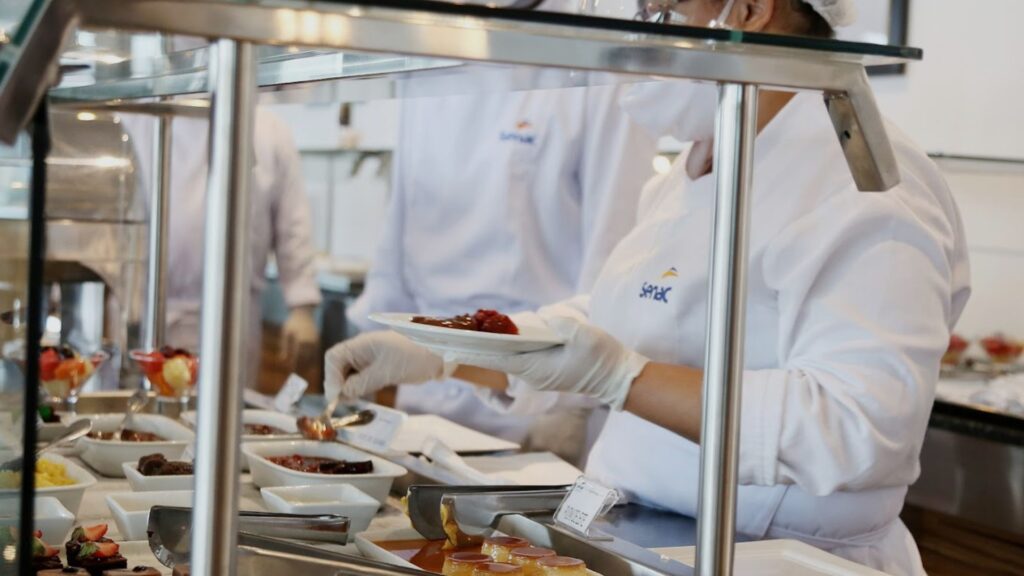
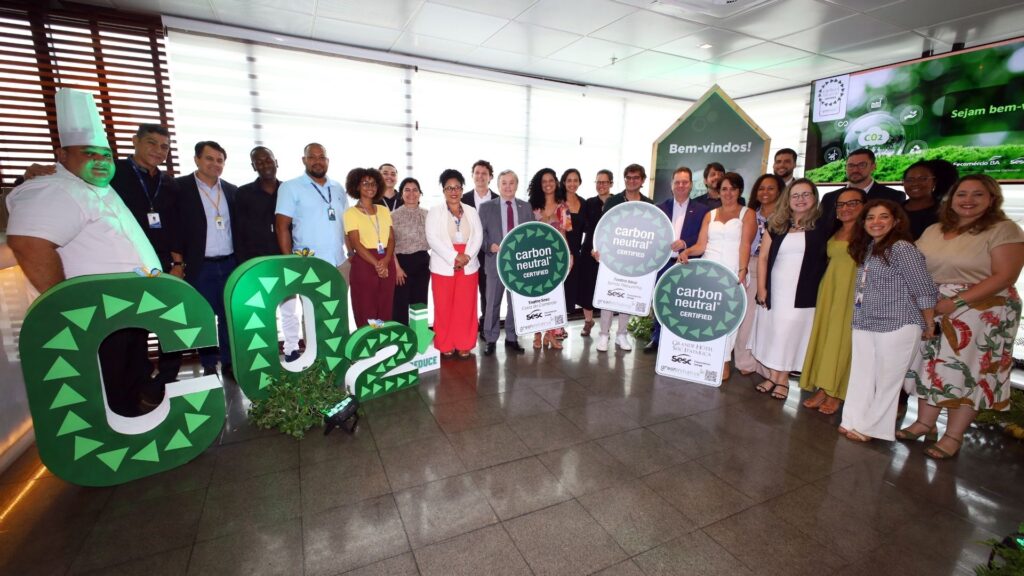
SUSTAINABILITY | CLIMATE ACTION | PROFESSIONAL EDUCATION In January 2026, five units of SESC and SENAC Bahia received or renewed their Carbon Neutral certifications by GI International, consolidating the most comprehensive decarbonization project in the service and professional education sector in Brazil. When, in 2022, the Senac Bahia Casa do Comércio Restaurant-School became the first Carbon Neutral certified restaurant in Brazil, the achievement sounded like a promise: that sustainability and operational excellence could go hand in hand. Three years later, that promise was not only fulfilled but multiplied. In January 2026, five units of the Sistema Comércio Bahia came together in a certification ceremony that marked a new chapter in the history of climate action in the country’s service sector. The ceremony brought together two distinct but complementary processes. On one hand, the Carbon Neutral recertification of the Senac Bahia Casa do Comércio and Pelourinho Restaurant-Schools and the Grande Hotel Sesc Itaparica. On the other, the debut of two new spaces in this journey: the Sesc Casa do Comércio Theaters and the Sesc-Senac Pelourinho Theater, which achieved their first Carbon Neutral Certification, expanding the scope of the project to the cultural and events sector. The result is an unprecedented institutional climate action portfolio in Brazil: five certified units, covering gastronomy, hospitality, and culture, all operating in Salvador and the Baía de Todos os Santos, all committed to concrete decarbonization pathways through 2030. The progress of the Restaurant-Schools: growing without compromising the climate The Senac Bahia Casa do Comércio Restaurant-School completed in 2025 its third greenhouse gas inventory, referring to the year 2024, and the numbers tell a story of decoupling between growth and environmental impact, something rare and valuable in the gastronomic sector. In 2024, the restaurant served 94,515 people, an increase of 23.2% compared to 2023. In contrast, absolute emissions increased only 10.9%, rising from 1,089.32 to 1,212.94 tons of CO2eq. What is most impressive, however, is the emissions intensity indicator per person served: 12.78 kgCO2eq per client, a reduction of 9.96% compared to 2023 and an expressive 26.7% compared to the base year of 2021. This accumulated reduction of 26.7% in just three years is no coincidence. It results from strategic, consistent, and measurable decisions. The most impactful of these was the reformulation of the menu: emissions associated with beef and lamb per person served fell 26.13%, as a result of conscious substitution with lower environmental impact proteins, such as seafood, poultry, and pork. The purchase of 100% renewable energy through the free market completely eliminated emissions from electricity consumption (Category 2), an achievement that remains a pillar of the decarbonization strategy. The 90.44% reduction in paper consumption per person served also deserves attention, resulting from an operational transformation that goes beyond symbolism. The most revealing result lies in the trajectory relative to the 2030 target. The restaurant had projected reaching 14.54 kgCO2eq per person as an intermediate benchmark in 2024. By achieving 12.78, it was approximately one to two years ahead of the planned schedule. This means that the target of a 50% reduction by 2030, starting from 17.44 kgCO2eq/person in the base year, is not only on the horizon but appears achievable ahead of schedule. The Senac Bahia Pelourinho Restaurant-School, in turn, completed in 2024 its first year post-baseline, in an inaugural monitoring cycle. With a total footprint of 1,283.22 tCO2eq and an intensity indicator of 12.18 kgCO2eq per person served (calculated over 105,345 clients), Pelourinho establishes its starting line clearly. The first decarbonization cycles often present adjustment challenges, and Pelourinho was no exception: a 14.91% increase in absolute emissions alongside a 6.64% increase in audience signals the path still to be traveled. Even so, positive results are already emerging: solid waste decomposition fell 33.08% per person served, and employee commuting decreased 12.13%. The 50% reduction target by 2030, based on the 11.30 kgCO2eq/person indicator in 2023, is ambitious and achievable, especially with the implementation of the structured actions in the Climate Action Plan that will be put into practice starting in 2025. Grande Hotel Sesc Itaparica: 41.48% reduction in emissions intensity Among all the decarbonization stories celebrated in January 2026, that of the Grande Hotel Sesc Itaparica may be the most eloquent in numerical terms. In its second Carbon Neutral certification cycle, the hotel presented results that challenge the conventional logic that growth and emissions reduction are conflicting objectives. In 2024, the hotel recorded a 13.84% increase in the number of overnight stays, rising from 38,447 to 43,767. Simultaneously, absolute emissions fell 33.38%, from 1,966.34 to 1,309.90 tCO2eq. The intensity indicator per overnight stay dropped from 51.14 to 29.93 kgCO2eq, a reduction of 41.48% in a single cycle. This result demonstrates real gains in carbon management efficiency and does not stem from a single isolated action, but from a set of operational transformations. The transition to 100% renewable energy, with I-REC certification, completely eliminated emissions from electricity consumption, which in 2023 represented 38.61 tCO2eq. The production of raw materials and inputs, the main source of emissions in any hospitality operation, decreased 32.87% in absolute values and 41.03% in intensity. Employee commuting decreased 32.97% in absolute terms. Improved data collection on refrigerant gases, adopting a methodology based on primary replenishment data instead of estimates based on average rates, also contributed to more accurate and representative measurement of operational reality. The Grande Hotel Sesc Itaparica concretely illustrates that sustainable tourism is not a niche or an aspiration: it is a viable business strategy that delivers economic and environmental value simultaneously. Located on the island of Itaparica, in the Baía de Todos os Santos, the hotel also carries the symbolic weight of protecting one of the richest marine ecosystems in the southern hemisphere. Expansion into culture: the Sesc Theaters reach certification The major new development in January 2026 was the incorporation of two theaters into Sesc Bahia’s Carbon Neutral portfolio. The Sesc Casa do Comércio Theater and the Sesc-Senac Pelourinho Theater conducted their first greenhouse gas inventories, referring to the year 2024, and immediately achieved Carbon Neutral
SESC & SENAC Bahia: Historic Expansion of Carbon Neutral Certification Read More »