
sustainable hospitality

Master the hotel energy transition with solar, wind, and hybrid systems. Learn how to integrate renewable energy into your property for cost savings and resilience.

Renewable Energy Integration for Hotels: Solar, Wind, and Hybrid Systems

For the hospitality sector, the transition to renewable energy is the most visible signal of climate leadership. While energy efficiency reduces the load, renewable integration eliminates the carbon intensity of the remaining energy demand. However, hotels face unique spatial and aesthetic challenges when deploying these technologies. This guide analyzes how to integrate solar, wind, and hybrid systems into hotel infrastructure to achieve energy independence and long-term cost stability. The Strategic Shift to On-Site Generation Modern hotels are no longer just energy consumers; they are becoming “prosumers”—entities that both consume and produce energy. Integrating renewable systems protects the property from the volatility of fossil fuel prices and grid instability. For example, for destinations in Peru, ranging from the Andean highlands to the Amazonian basin, decentralized renewable energy is often more reliable and cost-effective than traditional grid extensions. Financial and Regulatory Incentives Many jurisdictions offer accelerated depreciation, tax credits, or net-metering schemes for hotels that export excess renewable energy back to the grid. These financial mechanisms, combined with the plummeting cost of photovoltaic (PV) hardware, have brought the Return on Investment (ROI) for many hotel solar projects down to 4 to 6 years. Solar Energy: The Foundation of Hotel Renewables Solar Photovoltaic (PV) technology is the most common renewable choice for hotels due to its scalability and low maintenance requirements. Rooftop and Building-Integrated Photovoltaics (BIPV) Solar Thermal for Hot Water While PV generates electricity, solar thermal systems use the sun’s heat directly to warm water for guest rooms, laundries, and swimming pools. Solar thermal is significantly more efficient per square meter than PV for heating applications, making it a “quick win” for high-occupancy resorts. Wind Energy: Specialized Applications Wind energy is less common in urban hospitality but highly effective for coastal or remote highland properties with consistent wind profiles. Micro-Wind Turbines Unlike the massive turbines seen in industrial wind farms, micro-wind turbines are designed for building integration. Vertical Axis Wind Turbines (VAWTs) are quieter and can capture wind from any direction, making them suitable for coastal resorts where sea breezes are constant. Site Assessment Requirements Wind projects require at least 12 months of localized anemometer data to ensure viability. Because of the potential for noise and vibration, turbines must be strategically placed away from guest quiet zones. Hybrid Systems and Energy Storage The primary challenge of renewable energy is intermittency—solar does not work at night, and wind is variable. Hybrid systems solve this by combining multiple energy sources and storage. Solar-Wind Hybrids By combining solar and wind, hotels can achieve a more balanced generation profile. In many regions, wind speeds are higher at night or during cloudy days when solar production is low. Battery Energy Storage Systems (BESS) To achieve true energy independence or “Peak Shaving,” hotels are increasingly installing lithium-ion or flow batteries. Overcoming Implementation Barriers Aesthetic Integration Luxury hotels often hesitate to install renewables for fear of disrupting the “guest experience.” Modern design solves this by hiding panels behind parapet walls or using colored solar glass that mimics traditional building materials. Is your property suitable for solar or wind? Request a Renewable Energy Feasibility Study from Green Initiative’s technical experts. This article was written by Musye Lucen from the Green Initiative Team. Frequently Asked Questions (FAQ) for Hotel Renewable Energy Integration Related Reading

Renewable Energy Integration for Hotels: Solar, Wind, and Hybrid Systems Read More »
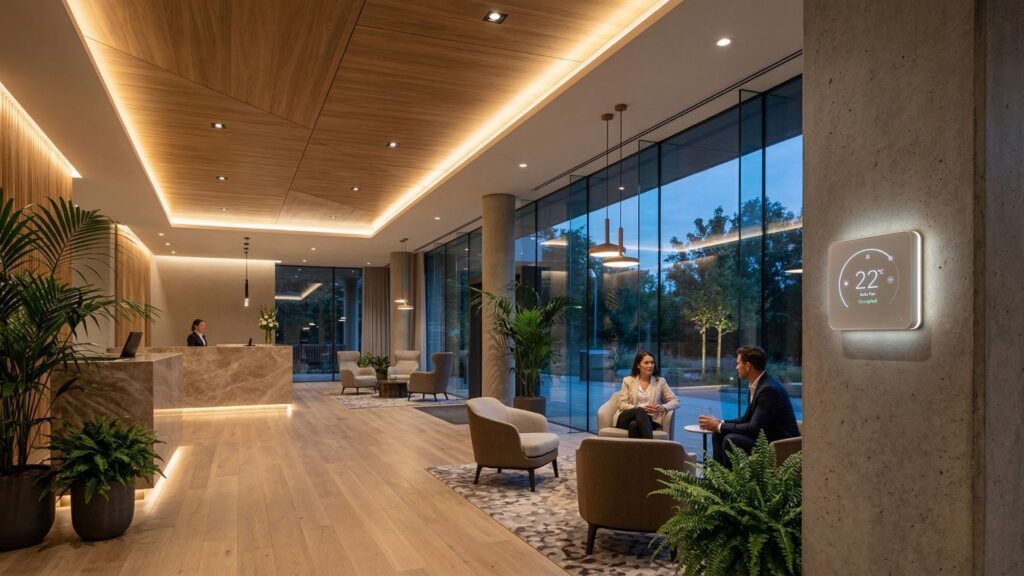
Modern luxury hotel lobby featuring energy-efficient LED lighting and a smart thermostat interface on a concrete pillar.

Hotel Lighting and HVAC Optimization: Quick Wins for Energy Reduction

Energy consumption represents one of the most significant operational costs for hotel owners and managers. Within a typical property, lighting and HVAC (Heating, Ventilation, and Air Conditioning) systems account for the vast majority of electricity use. Implementing targeted optimizations in these two areas provides immediate financial relief and serves as a foundational step toward broader decarbonization. This guide focuses on high-impact “quick wins” that deliver measurable results with minimal operational disruption. Implementing these quick wins is the first phase of a larger Complete Hotel Energy Transition Roadmap. The Financial Case for Rapid Energy Optimization Rising energy prices and increasing guest expectations for sustainable operations make efficiency a business imperative. Traditional lighting and unoptimized climate control systems waste significant resources through heating or cooling unoccupied spaces and using outdated technology. By focusing on lighting and HVAC, hotel operators can often see energy savings of 20% to 40% in these specific systems. These savings directly improve the property’s Net Operating Income (NOI) and increase overall asset value. These efficiency measures align with the broader Net Zero Roadmap for Travel & Tourism, providing a structured path toward total operational sustainability. Lighting Optimization: Illumination with Efficiency Lighting is often the most accessible area for rapid energy reduction. The transition to modern technology goes beyond simply changing bulbs; it involves intelligent control of the hotel’s environment. LED Retrofitting Replacing all incandescent, halogen, and fluorescent lamps with high-efficiency LED technology is the single most effective lighting intervention. Smart Controls and Automation Energy is frequently wasted in “back-of-house” areas and guest corridors that remain fully lit while empty. HVAC Optimization: Precision Climate Control HVAC systems are typically the largest energy consumers in any accommodation facility. Because these systems are complex, many hotels operate them inefficiently by default. Smart Thermostats and Occupancy Integration Heating or cooling a vacant guest room is a primary source of energy waste. Preventative Maintenance as an Efficiency Strategy A poorly maintained HVAC system can consume up to 30% more energy to provide the same level of comfort. Measuring Success and ROI The success of these “quick wins” is measured through utility bill reduction and improved equipment lifespans. Operators should establish a baseline of energy use per occupied room to track the specific impact of lighting and HVAC upgrades. These metrics are essential for demonstrating the value of efficiency projects to owners and investors. The potential for impact is significant; for instance, the Grande Hotel Sesc Itaparica efficiency results showed a 41.48% reduction in emissions intensity through strategic energy decisions. Ready to identify the specific savings available at your property? Book a Hotel Energy Efficiency Assessment with our technical team today. This article was written by Musye Lucen from the Green Initiative Team. Frequently Asked Questions: Hotel Energy Optimization Related Reading

Hotel Lighting and HVAC Optimization: Quick Wins for Energy Reduction Read More »

A modern eco-friendly hotel with rooftop solar panels, vertical green walls, and an electric vehicle charging station at sunset, illustrating the hospitality energy transition.A modern eco-friendly hotel with rooftop solar panels, vertical green walls, and an electric vehicle charging station at sunset, illustrating the hospitality energy transition.

Hotel Energy Transition: The Complete Decarbonization Roadmap for Accommodation Providers

The hospitality industry stands at a defining crossroads where economic growth must reconcile with the preservation of the ecosystems that sustain it. For hotels and accommodation providers, the energy transition represents the most significant opportunity to reduce operational costs while responding to a global demand for transparency and positive climate impacts. This roadmap provides a comprehensive strategic framework to transition from fossil-fuel dependency to climate-positive operations, utilizing the specialized guidelines established for the tourism sector. The Strategic Imperative for Hotel Decarbonization Decarbonizing the tourism sector is not merely a reputational exercise; it is a central dimension of modern industrial competitiveness. Accommodation providers face unique vulnerabilities to climate change, including extreme weather events that can damage infrastructure and disrupt service delivery. Economic Advantages and Risk Mitigation Transitioning to low-carbon models allows hotels to: Market Positioning and Guest Expectations Modern travelers increasingly prefer “climatically intelligent” options that reflect responsible practices. Demonstrating a verified commitment to action—such as through Carbon Neutral or Climate Positive certifications—provides a significant comparative advantage in international markets. Phase 1: Establishing the Carbon Baseline A credible energy transition begins with data. You must establish a rigorous Line Base of Emissions to quantify the impact of your operations. The Technical Audit Process Following international standards like ISO 14064-1 and the GHG Protocol, hotels must categorize emissions into three scopes: Measuring Methodology Quantification combines activity data (e.g., kWh consumed or liters of fuel) with emission factors—coefficients that estimate the total gases emitted per unit of activity. These calculations must include all primary greenhouse gases, primarily CO2, CH4, and N2O, expressed as CO2 equivalent (tCO2eq) for standardization. Phase 2: The Efficiency-First Framework Efficiency is the most cost-effective way to begin the transition. In the hospitality sector, the Accommodation category is a primary driver of emissions, largely due to electricity and heating requirements. Key immediate actions include optimizing HVAC systems and upgrading to LED lighting with motion sensors to achieve rapid energy reduction. HVAC and Building Optimization Heating, ventilation, and air conditioning systems are high-consumption areas. Phase 3: Implementing Circularity in Energy and Materials The energy transition is more effective when integrated with Circular Economy principles. Circularity moves away from the “extract-produce-discard” linear model to create resilient, closed-loop systems. The 10R Strategy for Hotels Hotels can apply the 10R Framework to minimize resource pressure: Case Study: Circularity in Peru Machu Picchu became a global reference by implementing an integrated circular architecture. Key interventions included: Phase 4: Electrification and Renewable Energy Once efficiency is maximized, the remaining load should transition to clean energy sources. Phasing Out Fossil Fuels Direct emissions can be lowered by switching from carbon-intensive cooking fuels to cleaner alternatives like natural gas or, ideally, full electrification. While electrification often produces the greatest net reduction, the local grid’s carbon content must be considered. Renewable Integration Phase 5: Monitoring, Reporting, and Verification (MRV) The transition is a continuous process of improvement. Reporting and diffusion of good practices generate the true value of climate investments. Principles of Reliable Reporting To ensure transparency and access to green finance, hotel reports must follow these principles: Maturity Levels Hotels can track their progress using the Climate Maturity Level (NM) framework: This article was written by Musye Lucen from the Green Initiative Team. Hotel Energy Transition FAQ Related Reading

Hotel Energy Transition: The Complete Decarbonization Roadmap for Accommodation Providers Read More »

Hotel Punta Sal: A Sustainable Commitment to Climate Mitigation and Carbon Footprint Reduction

Hotel Punta Sal: A Sustainable Commitment to Climate Mitigation and Carbon Footprint Reduction

In a world increasingly aware of the climate crisis, corporate environmental responsibility has become a key factor for competitiveness and long-term sustainability. A clear example of this trend is Hotel Punta Sal (Tumbes, Peru), an establishment that has shown a strong commitment to sustainability and climate change mitigation. Measuring and Offsetting the Carbon Footprint In 2023, Hotel Punta Sal took a major step in its sustainability journey by measuring its carbon footprint and earning the Carbon Neutral Certification from Green Initiative. Measuring its carbon footprint was crucial to understanding the environmental impact of the hotel’s operations, identifying the areas that generate the highest greenhouse gas emissions. After this assessment, the hotel took action to offset its carbon footprint, demonstrating its commitment to reducing environmental impact and fulfilling its social responsibility. Based on this initial assessment — the baseline — the hotel identified mitigation opportunities and made significant investments in actions to reduce its emissions. Climate Action Plans In 2024, in addition to measuring and offsetting its carbon footprint, Hotel Punta Sal has also implemented several climate mitigation measures to tangibly reduce its environmental impact. Key efforts include: These initiatives are part of a broader Climate Action Plan and are expected to positively influence the hotel’s carbon footprint assessment for the cycle. By implementing these measures, the hotel reduces its carbon footprint, enhances its competitiveness in a market increasingly demanding sustainability, and demonstrates its commitment to global climate goals such as the Paris Agreement. As a key player in the climate agenda for tourism, Green Initiative is committed to supporting companies like Hotel Punta Sal, which will join a select group of Latin American signatories of the Glasgow Declaration, accelerating progress toward decarbonizing the tourism sector. Benefits of Climate Action Hotel Punta Sal’s commitment to climate action also brings economic and strategic advantages: A More Sustainable Future Hotel Punta Sal is a prime example of how the tourism industry can play a crucial role in the fight against climate change. By measuring and offsetting its carbon footprint, implementing sustainable technologies, and adopting a Climate Action Plan with mitigation measures, the hotel not only protects the environment but also ensures its future viability and competitiveness. With its continued efforts to integrate climate action into its business model, Hotel Punta Sal positions itself as a leader in sustainability in Peru and globally, proving that climate action is essential not only for the planet but also for long-term business success and prosperity. This article was written by Tatiana Otaviano from the Green Initiative Team. Related reading

Hotel Punta Sal: A Sustainable Commitment to Climate Mitigation and Carbon Footprint Reduction Read More »