
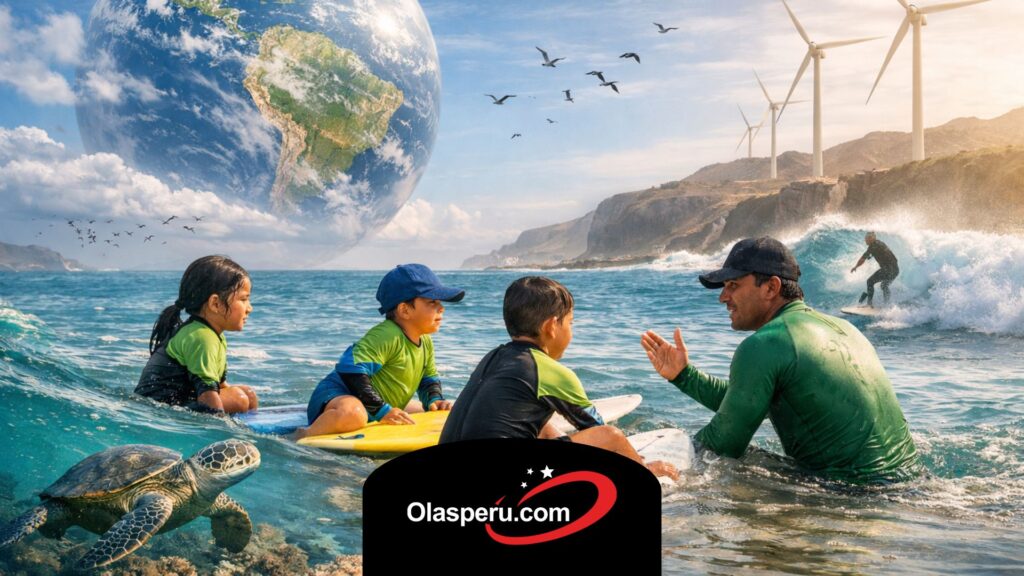
Learning to Listen to the Ocean: How Surf Education Is Shaping Environmental Awareness and Climate Action in Peru
As climate change accelerates and ocean ecosystems face unprecedented pressure, one truth becomes increasingly clear: we cannot protect what we do not understand — and we cannot understand what we do not experience. The ocean regulates the planet’s climate, produces more than half of the oxygen we breathe, and sustains millions of livelihoods. Yet, for much of society, it remains distant — admired, consumed, or exploited, but rarely listened to. At Green Initiative, we believe that education is one of the most powerful drivers of climate action and ecosystem restoration. Not education confined to classrooms alone, but lived, experiential learning that builds respect, responsibility, and long-term stewardship. This is where the story of Roberto “Muelas” Meza — pioneer of modern surfing in Peru and founder of Olas Perú — becomes deeply relevant More than a surf coach, Muelas is an educator of the ocean. His life’s work demonstrates how sport, culture, and environmental education can converge into a practical model for sustainability and climate responsibility. From Waves to Wisdom: When the Ocean Becomes a Classroom Long before sustainability became a global agenda, Roberto Meza was already learning its core lesson from the sea: humility. As a young boy watching surfers at Makaha, he entered the ocean for the first time on a borrowed board. He didn’t stand for more than a few seconds — but he felt something that would define his life. “That feeling of floating and falling into the water changed me forever. I understood the ocean had something to teach me.” This relationship — based not on control, but on listening — would later shape an entire educational philosophy. In the early days of Peruvian surfing, there were no schools, no sponsorships, and no formal structures. Learning happened through observation, trial and error, and collective support. That sense of community and shared responsibility would become the backbone of Olas Perú decades later. Surfing as Environmental Education For Muelas, surfing stopped being just a sport when he realized its transformative power: “The ocean teaches patience, respect, humility. Those lessons matter more than any trophy.” This understanding aligns closely with Green Initiative’s approach to sustainability: lasting climate action begins with mindset change, not only metrics. Surfing teaches: In other words, it builds people capable of caring for nature, not just using it. The Birth of Olas Perú: A School for Life In 1992, Roberto Meza founded Olas Perú with a clear purpose:not to produce champions alone, but to form people of the sea. “Training a surfer is easy. Training a person of the sea is what truly matters.” Olas Perú became a space where children and young people learn: Among its first students was Sofía Mulanovich, who would later become a world champion — a powerful reminder that education rooted in values produces excellence naturally. Climate Action in Practice: Carbon Neutrality and Ocean Stewardship Today, Olas Perú is recognized as the world’s first carbon-neutral surf school, integrating: This practical commitment mirrors Green Initiative’s broader mission: transforming values into measurable, real-world climate action. “The ocean gives us everything. The least we can do is take care of it.” Rather than treating sustainability as an abstract concept, Olas Perú embodies it daily — proving that sports, education, and climate action are not separate worlds, but deeply interconnected. Listening to the Ocean: Leadership Lessons from the Sea One of Muelas’ most emblematic stories captures this philosophy perfectly. During a competition, a student was paralyzed by anxiety. Instead of giving technical advice, Muelas said: “Forget about winning. Just listen to the ocean.” The student calmed down, entered the water, and rode the best wave of his life. The lesson is simple — and universal:when we stop trying to dominate nature and start listening, better decisions follow. This applies not only to surfing, but to leadership, sustainability, and climate governance. A Shared Vision for the Future Looking ahead, Roberto Meza remains optimistic — with one condition: “The future is bright if we protect our beaches, keep our ethics, and strengthen our communities.” At Green Initiative, we share this conviction. There is no climate-positive future without education, ethics, and cultural transformation. Certifications, metrics, and technology are essential — but they must be grounded in people who truly understand their relationship with nature. Why This Story Matters Roberto “Muelas” Meza’s journey reminds us that: Teaching someone to surf, in this context, is ultimately teaching them how to live with awareness, responsibility, and respect for the planet. That is the kind of impact Green Initiative exists to support, scale, and certify — across tourism, sports, education, and beyond. 🌊 Olas Perú Questions & Answers What is Olas Perú? Olas Perú is a pioneering surf school based in Peru that integrates surf education with environmental awareness, community values, and ocean stewardship. Founded in 1992, it is recognized as the world’s first carbon-neutral surf school. Who is Roberto “Muelas” Meza? Roberto “Muelas” Meza is a pioneer of modern surfing in Peru and the founder of Olas Perú. He is an educator who uses the ocean to teach humility, responsibility, and respect for nature. How can surfing contribute to environmental education? Surfing creates direct, experiential contact with the ocean. By interacting with tides, waves, weather, and ecosystems, students develop environmental awareness and a strong sense of responsibility toward marine conservation. What does “people of the sea” mean? “People of the sea” are individuals who understand that the ocean is not something to dominate but to respect, emphasizing humility, patience, ethical behavior, and environmental stewardship. Why is experiential education important for climate action? Experiential education builds emotional connection and responsibility. Learning directly from nature transforms sustainability into a lived value, leading to more consistent and long-term climate action. What makes Olas Perú a carbon-neutral surf school? Olas Perú integrates environmental education, conservation practices, community engagement, and climate responsibility, reducing and compensating emissions while promoting ocean protection. How does surf culture relate to climate leadership? Surf culture fosters patience, adaptability, respect for natural limits, and collective responsibility, which are essential skills
