
carbon credits

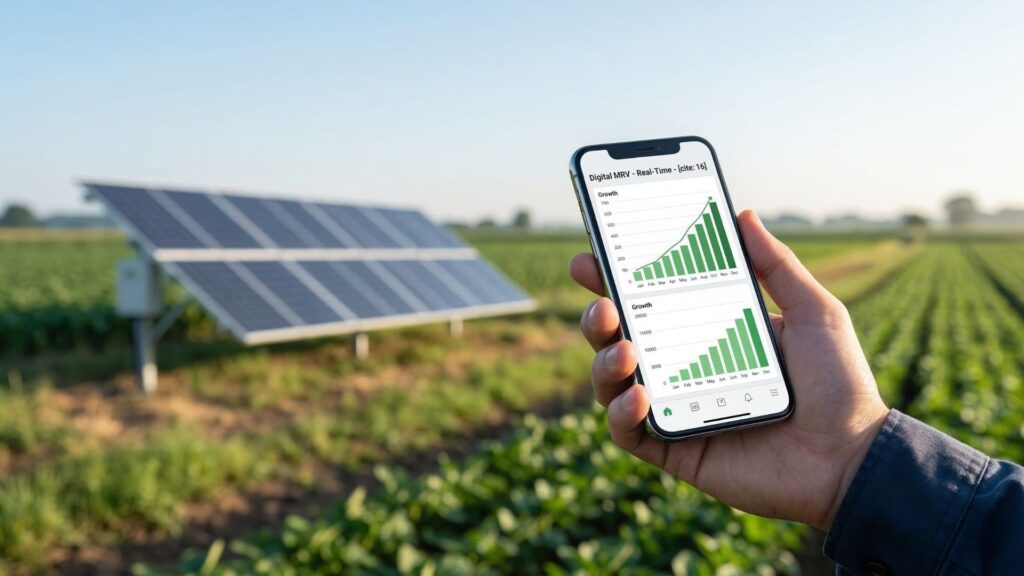
A person in an agricultural field holds a smartphone displaying a data dashboard with the text "Digital MRV - Real-Time", with a solar panel array in the background.

Digital MRV Platforms: How Technology Scales Climate Finance

The global SME financing gap stands at $5.5 trillion, partly due to the excessive cost of verifying impact for small-scale projects and for small-scale projects seeking Climate Positive Certification. Traditional MRV is “prohibitively expensive” for smallholder projects because manual registration and field visits take between 12 and 24 months, a timeline that is incompatible with the fast-paced capital needs of small businesses. Digital platforms and middleware are now enabling financial institutions to reach these borrowers profitably by aggregating risk and dramatically reducing transaction costs.  Automation and Aggregation: Solving the “SME Paradox” Traditional MRV is prohibitively expensive for smallholder projects because manual registration and field visits take 12 to 24 months. Digital platforms are transforming this through two core mechanisms:    Criteria for Evaluating Digital MRV Platforms When selecting a platform, financial institutions must prioritize transparency, accuracy, and cost-efficiency. The 2025 Technical Guidance from the World Bank identifies four high-priority workflows for digitization: measurement and data storage, emission reduction (ER) calculations, third-party verification, and reporting.  Feature-by-Feature Analysis: Digital MRV Solutions Feature Traditional MRV Digital MRV (dMRV) Green Initiative (GREENIA) Verification Cycle 12–24 Months 1–3 Months Real-Time Monitoring Data Ingestion Manual Entry / PDF API-based / Automated 100+ Built-in Integrations Audit Requirement Physical Site Visits Remote / Internet Audits Satellite + Ground Verification Integrity Layer High Human Error Risk Tamper-proof Logs AI-driven Anomaly Detection The GREENIA Advantage Green Initiative’s GREENIA platform serves as a novel artificial intelligence (AI)-powered framework for optimizing climate performance. A key innovation of GREENIA is its ability to provide natural language explanations (NLEs), enabling transparent and interpretable insights for both technical and non-technical stakeholders. Through the platform, businesses can monitor key climate performance indicators, execute real-time reports, and compare performance over time. Pros and Cons of Digital Integration Pros Limitations Use Case Recommendations Conclusion Digital MRV is the backbone of credible carbon projects and performance-linked lending. Platforms like GREENIA provide the transparency and rigor needed to align with global climate goals while making SME finance a profitable business decision. This article was written by Virna Chávez from the Green Initiative Team. Frequently Asked Questions References & Further Reading Related Reading

Digital MRV Platforms: How Technology Scales Climate Finance Read More »

Carbon Credits in 2025: A Turning Point for Climate Action?

Carbon Credits in 2025: A Turning Point for Climate Action?

The global carbon market is reaching a critical juncture. As climate action accelerates, governments, businesses, and financial institutions are increasingly integrating carbon credits into their sustainability strategies. However, challenges such as transparency, credibility, and market fragmentation persist. Could 2025 be the year that carbon credits transition from a supplementary tool to a mainstream climate action mechanism? Why Carbon Markets Matter for Climate Action Carbon credits play a crucial role in reducing greenhouse gas emissions, enabling companies to offset their carbon footprint through verified climate and nature positive initiatives. As regulatory frameworks evolve and demand for high-integrity carbon credits rises, businesses face growing pressure to make credible sustainability commitments. Wendy Chen, in her article for Climate & Capital Media, explores the key drivers shaping the carbon market, including policy incentives, technological advancements, and small and medium-sized enterprises (SMEs). Inspired by her insights, we examine whether 2025 could be the defining moment for carbon markets. Will Policy Incentives Make 2025 a Game-Changer? Governments are increasingly shaping carbon markets with stronger policies, aiming to ensure the credibility and accessibility of carbon credits. The integration of voluntary and compliance markets is a critical factor in determining whether 2025 will be a breakthrough year. Technological Innovations Strengthening Carbon Markets With the rise of artificial intelligence, cloud computing, and data centers, the tech sector’s carbon footprint has grown significantly. Leading corporations are responding by integrating carbon credits into their sustainability roadmaps, helping shape the future of carbon markets. SMEs and the Growing Role of Carbon Credits Historically, large corporations dominated carbon markets, but SMEs are now becoming key players in both the demand and supply of carbon credits. New Standards Enhancing Carbon Market Integrity As carbon markets scale, new standards are emerging to ensure accountability. Organizations like the Integrity Council for the Voluntary Carbon Market (ICVCM) and the Science-Based Targets initiative (SBTi) are raising the bar for carbon credit verification, helping build trust and drive market growth. The Expanding Role of Nature-Based Solutions Nature-based solutions such as reforestation, blue carbon projects, and regenerative agriculture are crucial for achieving climate and nature positive outcomes. These approaches help absorb CO₂ while preserving biodiversity and supporting local communities. Increasing investment in these projects will be vital in ensuring the integrity and impact of carbon credits. Are Carbon Removal Technologies the Future? Beyond traditional carbon offsets, businesses are investing in direct air capture (DAC), biochar, and enhanced weathering to permanently remove carbon from the atmosphere. These emerging technologies are gaining traction as companies seek long-term, high-impact solutions for carbon neutrality. Beyond Offsetting: Corporate Climate Strategies for 2025 While carbon offsetting remains an essential tool, many corporations are shifting towards insetting, integrating emission reduction measures directly within their supply chains. Companies like Nestlé and Unilever are investing in regenerative agriculture to cut emissions at the source, marking a broader transition toward holistic sustainability strategies. Financial Institutions and the Growth of Carbon as an Asset Class Banks, asset managers, and institutional investors are increasingly incorporating carbon credits into green bonds, carbon ETFs, and structured carbon finance mechanisms. As carbon markets mature, financial backing will be essential for scaling high-quality, impact-driven climate projects. Challenges and Opportunities in 2025 While the carbon credit market is expanding, hurdles such as additionality concerns, double counting, and verification inconsistencies still exist. Addressing these challenges will be crucial to ensuring carbon markets deliver real climate action and economic benefits. If 2025 is to be the turning point for carbon credits, stakeholders must work collaboratively to improve transparency, accessibility, and governance. With strong regulatory frameworks, technological innovation, and financial backing, carbon markets could become a cornerstone of global decarbonization efforts. At Green Initiative, we believe in advancing high-integrity carbon markets and guiding businesses on their path to net-zero emissions. As demand for climate and nature positive solutions grows, we support organizations in leveraging carbon finance opportunities for tangible environmental impact. This article was inspired by Wendy Chen’s insights in Climate & Capital Media. Her analysis provides valuable perspectives on the evolving carbon market landscape. Read her article here.

Carbon Credits in 2025: A Turning Point for Climate Action? Read More »