Bonito

How UNESCO Heritage Sites are Integrating Climate Action - Green Initiative

How UNESCO Designated Sites are Integrating Climate Action

Bonito and Machu Picchu: The Power of Twin UNESCO Designated Sites Pioneering Climate Action in Tourism In a time where climate change poses significant challenges to our planet, the tourism industry is stepping up to play a crucial role in mitigating its impact through the Glasgow Declaration for Climate Action in Tourism. In this context, two iconic cultural and ecotourism destinations are leading the way in climate action in tourism. Bonito, located in the Brazilian Pantanal and recognized as a UNESCO Biosphere Reserve, and Machu Picchu, situated in the Peruvian Andes and recognized as a UNESCO Mixed World Heritage Site, integrate climate mitigation best practices into their tourism development models. The results achieved so far, through the climate certification of both destinations, have consistently showcased that through well-informed and pragmatic action, the development of tourism in UNESCO Biosphere Reserves and Mixed World Heritage Sites can go hand in hand with the decarbonization of tourism destinations, generating positive impacts on both the local economy and the climate. Bonito and Machu Picchu: Laboratories for Climate Mitigation Action and Expertise Development Bonito, located in Mato Grosso do Sul, Brazil, was designated a UNESCO Biosphere Reserve in 2000. Bonito has long been a reference for sustainable tourism, known for its crystal-clear rivers, stunning waterfalls, and rich biodiversity. Similarly, Machu Picchu, the ancient Incan citadel nestled in the Andes Mountains of Peru, was declared a UNESCO Mixed World Heritage Site in 1983. In collaboration with the Green Initiative, both UNESCO destinations, Bonito and Machu Picchu, have embarked on a transformative journey to net-zero emissions through a rigorous climate-certification process that involves: In 2021, the tourism destination of Bonito had a total of 17,829.42 tCO2eq emissions. Around 51% of its footprint was related to the consumption of fuels by ground mobile sources, such as cars and buses used by tourists in their visits. The second largest emission was the decomposition of solid residues (22.32%), followed by electricity consumption (6.02%). In the development of Bonito’s Climate Action Plan, several actions were defined to address these core emissions, such as stimulating the use of biofuels, conversion and availability of electric vehicles, waste management improvements in the public system, community engagement in the circular economy, and carbon capture enhancements by promoting ecosystems restorations. On the other hand, in 2022, Machu Picchu successfully reduced its emissions to 7,117.55 tCO2eq, an 18.77% decrease from the 2019 base year. Four processes were implemented to reuse recoverable waste: Additionally, electric vehicles were introduced to transport the generated waste, and waste segregation points were established throughout the district, among other actions. The new waste management processes significantly reduced 40.80 tCO2eq, 2.5 times more than in 2019. Carbon capture from ecological restoration, where 6,596 native trees were planted in degraded areas, capturing 5,055.17 tCO2eq, led to a net emission balance of 2,062.38 tCO2eq. Machu Picchu’s carbon footprint has been fully offset with 2,155 carbon credits from the REDD+ Brazil Nut Concessions project by Bosques Amazónicos (BAM), which protects over 600,000 hectares of megadiverse forests and supports more than 800 Amazon Brazil nut harvesting families in Madre de Dios, Peru. By integrating climate action into their core business models, these destinations are setting new standards for sustainable tourism at UNESCO heritage sites. As Jose Salazar Ríos, Coordinator of the Culture Sector at UNESCO Peru, highlights: “Machu Picchu, one of the 13 World Heritage sites that Peru has, is an inspiring example of how tourism can be integrated with climate action, thus contributing to the sustainability and conservation of World Heritage.“ The Glasgow Declaration on Climate Action in Tourism The Glasgow Declaration on Climate Action in Tourism is a pivotal framework for mobilizing the tourism sector to act decisively on climate change. Launched at the UN Climate Change Conference (COP26) in Glasgow, the Declaration commits signatories to halve emissions by 2030 and achieve net zero by 2050 at the latest. By aligning with the pathways to the Paris Agreement, the Declaration provides a clear roadmap for tourism stakeholders to integrate climate action into their business models. It encourages collaboration across the industry, promoting the sharing of best practices, resources, and innovative solutions to accelerate decarbonization. Bonito and Machu Picchu are exemplary participants in this global movement, demonstrating how UNESCO heritage sites can lead by example in integrating comprehensive climate strategies into their tourism operations. Through initiatives such as these, the Glasgow Declaration aims to unify the tourism industry in the fight against climate change, fostering a collective effort to protect our planet for future generations. The Power of Twin UNESCO Designated Sites in Climate Mitigation The collaboration between Bonito and Machu Picchu, as climate-smart twin cities, holds immense potential for climate mitigation and expertise development worldwide. By sharing best practices, resources, and innovative solutions, they can amplify their impact on reducing tourism-related emissions and serve as a reference for other UNESCO Designated Sites worldwide. According to Sofia Gutierrez, Deputy Director of Sustainable Tourism at UN Tourism: “The experience of Machu Picchu as a signatory of the Glasgow Declaration can be a reference for other tourist destinations in Peru and around the world. In addition to being a natural and cultural treasure, Machu Picchu is also an inspiring example of how the growth of tourism and decarbonization can and should go hand in hand.“ Emerging Opportunities Final Reflections Bonito, as a UNESCO Biosphere Reserve, and Machu Picchu, as a UNESCO Mixed World Heritage Site, both as Carbon Neutral destinations, can provide the tourism industry significant insights into the fight against climate change. Their reinforcement of bilateral collaboration as climate-smart twin cities holds the potential to drive substantial progress in decarbonizing tourism and promoting sustainable development both locally and worldwide. By working together, they can inspire other destinations to follow suit, creating a ripple effect that contributes to a more sustainable and resilient planet. As we look to the future, Bonito’s and Machu Picchu’s partnership serves as a testament to the power of collaboration in addressing the pressing challenges of climate change. Together, they are preserving their natural and cultural

How UNESCO Designated Sites are Integrating Climate Action Read More »
Join the 2º Climate Action in Tourism Seminar Financing Perspectives for Sustainable Decarbonization Bonito Mato Grosso do Sul Brasil Green Initiative

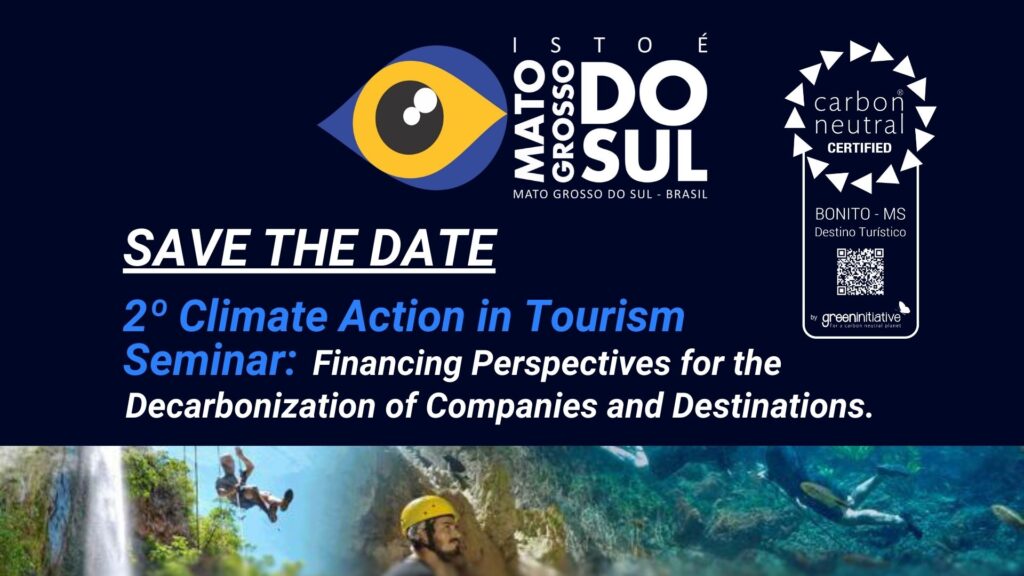
(updated) Join the 2º Climate Action in Tourism Seminar: Financing Perspectives for Sustainable Decarbonization

Are you ready to take meaningful steps towards decarbonizing the tourism sector? Don’t miss the opportunity to participate in the 2º Climate Action in Tourism Seminar, focusing on Financing Perspectives for the Decarbonization of Companies and Destinations. Post Event: Watch The Seminar Here Grupo Rio da Prata ecotourism receives the Climate Positive Certification from Green Initiative at the seminar. Registration Closed! You Can Still Participate Online What to Expect? This seminar is promoted by the Mato Grosso do Sul Tourism Foundation (FUNDTUR) and Green Initiative and offers a comprehensive overview of commitments and trends in decarbonizing the tourism industry, specifically tailored to the Brazilian context. Join us to explore: Why Participate? By joining this seminar, you’ll gain: Event Details: Seats are limited, so secure your spot now! (registration for in person participation closed, join online here) Agenda and Registration: Click here to view the complete agenda for the event and register for in-person participation. Take advantage of this unique opportunity to contribute to the decarbonization of the tourism sector. Your participation will be instrumental in shaping a more sustainable future for tourism. Let’s work together towards a greener, more resilient tourism industry. See media repercussions here; quick links below

(updated) Join the 2º Climate Action in Tourism Seminar: Financing Perspectives for Sustainable Decarbonization Read More »

Green Initiative National Tourism Award Prêmio Nacional Do Turismo

Green Initiative Two Brazilian Partners as Finalists in the National Tourism Award 2023

We are thrilled to announce that two of our esteemed partners have been selected as finalists for the prestigious National Tourism Award 2023: Tourism Transforming Lives (“Prêmio Nacional Do Turismo 2023: O Turismo Transformando Vidas”), held by the Brazilian Ministry of Tourism. The Green Initiative team is proud to showcase the outstanding initiatives of: We are immensely proud of our partners for their remarkable contributions to Brazilian tourism, such as the “Guia Brasileiro De Ação Climática Para Empresas e Destinos Turísticos” (Brazilian Climate Action Guide For Tourism Businesses and Destinations), developed by Green Initiative in alliance with the brazilian Ministry of Tourism and EMBRATUR (Brazilian Agency for International Tourism Promotion), promoting sustainability, and setting global benchmarks. These initiatives not only represent excellence in the field but also demonstrate a commitment to environmental responsibility and positive climate action. Congratulations to Fundação de Turismo de Mato Grosso do Sul and Estância Mimosa Ecoturismo LTDA! Your dedication to transforming tourism and the environment is truly commendable, and we look forward to witnessing your success in the upcoming awards ceremony. We encourage everyone to support and celebrate these remarkable initiatives. To contact us, please click here.

Green Initiative Two Brazilian Partners as Finalists in the National Tourism Award 2023 Read More »

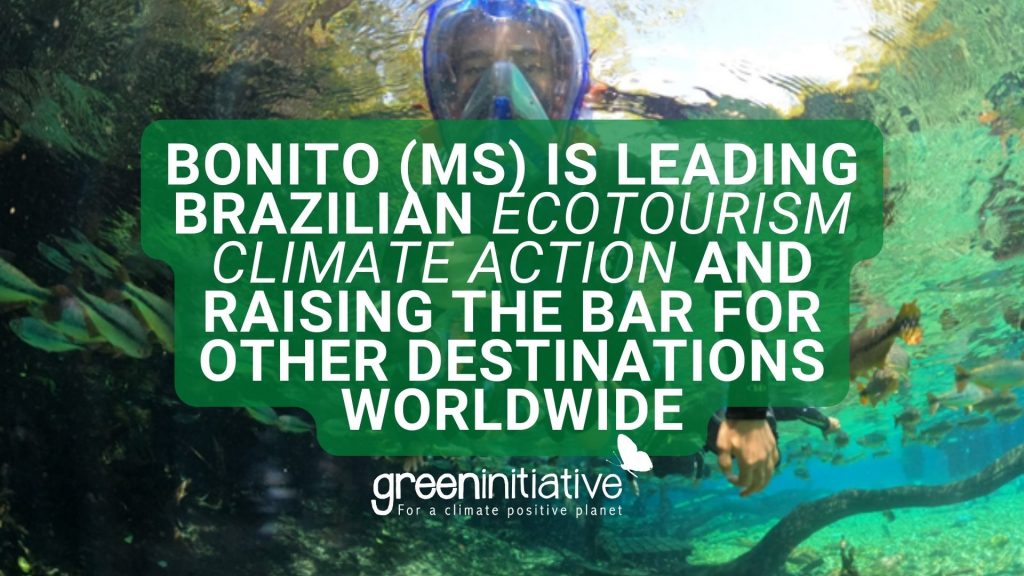
Bonito (MS) is Leading Brazilian ecotourism Climate Action and raising the bar for other destinations worldwide

Bonito: How a Brazilian ecotourism destination is leading climate action by example

As the world recovers from the shock of the COVID-19 pandemic, rebuilding a more sustainable tourism sector remains a shared responsibility of tourism firms and destinations. Amid mounting evidence of severe climate change, points that the window of opportunity to rapidly reduce greenhouse gas (GHG) emissions and avoid a climate disaster is rapidly narrowing. Atmospheric temperatures have already increased by about 1⁰ Celsius from preindustrial levels, and keeping that increase to less than 1.5⁰ through 2050 will require intense efforts by the public and private sectors. At the COP26 conference in November 2021, the UN World Tourism Organization (UNWTO), the United Nations Environment Program (UNEP) and their partners issued the Glasgow Declaration for Tourism and Climate, which calls on all tourism stakeholders to demonstrate a shared commitment to mitigating greenhouse gas (GHG) emissions by integrating climate action into the core of tourism business models and management tools. Brazil’s ecotourism industry relies on landscapes with extraordinary biodiversity and vibrant ecosystems that provide food and shelter for native species. One of Brazil’s key ecotourism centers is Bonito, a fantastic destination in Mato Grosso do Sul that rests atop the Guarani Aquifer, the second largest source of freshwater on earth. Bonito’s efforts to achieve carbon-neutral certification are based on over two decades of implementing sustainable tourism management practices. As early as 1995, Bonito created a Tourism Voucher system that is designed to control the number of tourists per attraction based on a scientific reference point for tourist capacity, and Bonito has since emerged as one of the most lauded ecotourism destinations in the country. After Bonito received the WTN Global Responsible Tourism Award in 2013 (London), government authorities launched a public-private destination governance body – FUNDTUR, which plays a key role in promoting sustainable tourism development best practices for Bonito. The carbon neutral certification process led by Green Initiative, was initiated with the signing of the Glasgow Declaration by FUNDTUR, in coordination with the Bonito municipal government and the state secretariats for the environment, tourism, and economic development. The carbon-neutral certification cycle requires an accurate assessment of the destination’s carbon footprint. This footprint establishes the baseline for reducing Bonito’s carbon emissions, which will need to fall by 45% by 2030 and reach net zero by 2050, in accordance with the guidelines of the Paris Agreement. The certification process also includes an assessment of the GHG capture and storage capacity of local forests, which include eight of Bonito’s main ecotourism attractions spread over 5,000 hectares. According to the carbon-footprint assessment, the main GHG emission sources are fuel consumption by vehicles (52,36% of total emissions), followed by the decomposition of solid waste (22,64%). The mitigation plan will focus first on solid-waste management (including food waste), reducing methane emissions at landfills by channeling organic waste to appropriate sites through governmental and community programs. In addition to reducing GHG emissions, the proper treatment of organic waste can provide opportunities to produce valuable products such as biochar, compost, biogas, and organic fertilizers. Local farmers can use organic fertilizers as a substitute for nitrogen-based fertilizers, further slashing GHG emissions from agriculture while complementing ecosystem restoration and reforestation projects currently underway. Reducing the carbon footprint of cars, trucks, and motorcycles will be vital to achieve Bonito’s climate targets. Vehicle emissions pose an especially complex challenge, and emissions reduction will require sustained investments in electric mobility. By developing the capacity to measure and monitor its climate performance, Bonito is raising the bar in climate action for ecotourism destinations world-wide, leading the way to new destination management practices, that should mainstream climate action as a significantly relevant aspect for long-term prosperity for any destination. This article for Transforming One Planet Vision into Action has been prepared by FUNDTUR, Mato Grosso do Sul Destination Management Organization. For more information visit Green Initiative website. Green Initiative, a leading sustainable certification company, is proud to announce that it has partnered with the UNWTO and the Travel Foundation to support the Glasgow Declaration Capacity Building Working Group. ENGAGE NOW Commit to a new level of leadership and competitiveness in the tourism industry by introducing climate action at the core of your business model, and become Climate Positive, Carbon Neutral and /or Carbon Measured certified. Click here to learn more about Green Initiative Certifications and Climate Action Solutions for Tourism.

Bonito: How a Brazilian ecotourism destination is leading climate action by example Read More »

Brazil is on its way to Certifying the First Carbon-Neutral Ecotourism Destination Worldwide

Mainstreaming climate Action Bonito is mainstreaming carbon action to become the first carbon-neutral certified tourism destination. Brazil’s ecotourism is dominated by landscapes with astonishing biodiversity hotspots and vibrant ecosystems that provide food and shelter for native species. One of Brazil’s ecotourism “jewels” is Bonito, a small destination in Mato Grosso do Sul, which happens to be on top of the second largest fresh water on earth – The Guarani Aquifer. sustainable tourism As the world continues to recover from the unprecedented shock of the COVID-19 pandemic, rebuilding a more sustainable tourism sector remains a shared responsibility of tourism businesses and destinations worldwide. At the COP26 climate change conference held in November 2021, the UN World Tourism Organization (UNWTO), the United Nations Environment Program (UNEP), and their partners issued the Glasgow Declaration on Tourism and Climate. In this context, since August 2022, the Tourism Authority of Mato Grosso do Sul  (FUNDTUR) has started a relevant effort to certify Bonito as the first Carbon Neutral ecotourism destination worldwide. According to Bruno Wendling, President of  FUNDTUR:  “our goal is to generate new capabilities to proactively and strategically execute GHG management, which will lead to climate-smart tourism products and services and the strategic positioning of Bonito as an international ecotourism destination”. Climate Action In practice, this means that Bonito will start the implementation: (i) concrete mitigation actions to avoid and reduce GHG emissions through investments in energy efficiency, renewable energy, and the circular economy. (ii) work on incentives to attract and promote private investment that seeks a positive impact on climate and biodiversity. Bonito’s climate certification cycle is led by Green Initiative, which was also responsible for the carbon-neutral certification of Machu Picchu. In addition to supporting Bonito’s carbon footprint analysis, Green Initiative is evaluating the carbon sinking capacity of the local forest within the specific scope of tourist attractions. With the development of the ability to measure and monitor Bonito’s climate performance, it will be possible to set emission targets, assess progress and, through this, attract investments and climate finance that allow us to boost the international competitiveness of the Bonito destination. Learn how to engage your Business in a New Level of Leadership and Competitiveness. Become Climate Positive, Climate Neutral, and Climate Measured Certified here.

Brazil is on its way to Certifying the First Carbon-Neutral Ecotourism Destination Worldwide Read More »