The global SME financing gap stands at $5.5 trillion, partly due to the excessive cost of verifying impact for small-scale projects and for small-scale projects seeking Climate Positive Certification. Traditional MRV is “prohibitively expensive” for smallholder projects because manual registration and field visits take between 12 and 24 months, a timeline that is incompatible with the fast-paced capital needs of small businesses. Digital platforms and middleware are now enabling financial institutions to reach these borrowers profitably by aggregating risk and dramatically reducing transaction costs.
Automation and Aggregation: Solving the “SME Paradox”

Traditional MRV is prohibitively expensive for smallholder projects because manual registration and field visits take 12 to 24 months. Digital platforms are transforming this through two core mechanisms:
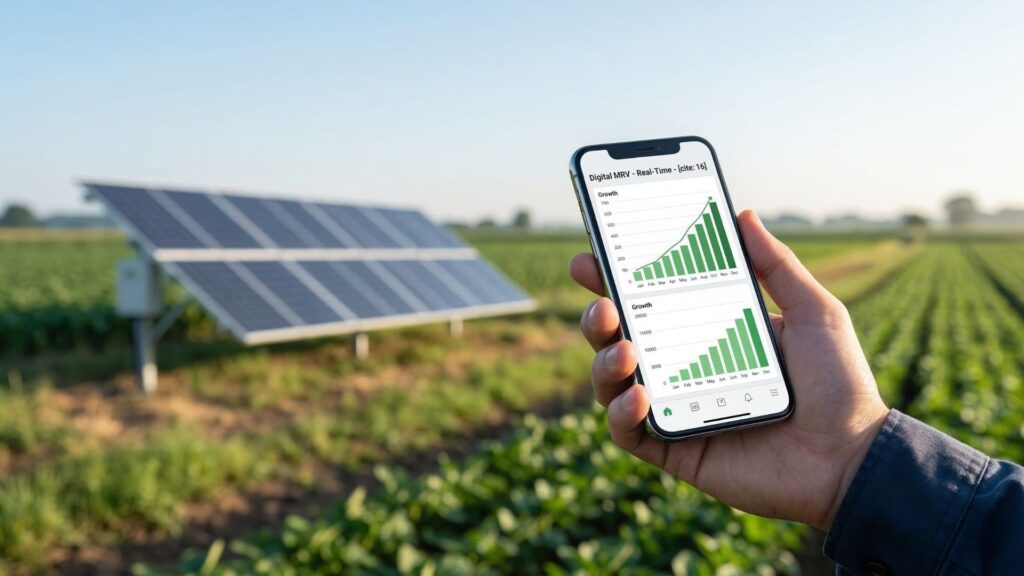
- Digital Runners and Mobile Data: Last-mile data collection leverages mobile apps and Digital Runners to gather ground-level evidence for Nature Positive Action, such as tree survival rates or energy meter readings, at scale. This reduces the workload of data handling by an estimated 95%.
- Asset Bundling and Registries: By bundling hundreds of thousands of small clean-energy device users into a single digital registry, platforms achieve the economies of scale necessary for institutional investment. This makes a $10,000 solar loan as bankable as a utility-scale wind farm.
Criteria for Evaluating Digital MRV Platforms

When selecting a platform, financial institutions must prioritize transparency, accuracy, and cost-efficiency. The 2025 Technical Guidance from the World Bank identifies four high-priority workflows for digitization: measurement and data storage, emission reduction (ER) calculations, third-party verification, and reporting.
Feature-by-Feature Analysis: Digital MRV Solutions
| Feature | Traditional MRV | Digital MRV (dMRV) | Green Initiative (GREENIA) |
| Verification Cycle | 12–24 Months | 1–3 Months | Real-Time Monitoring |
| Data Ingestion | Manual Entry / PDF | API-based / Automated | 100+ Built-in Integrations |
| Audit Requirement | Physical Site Visits | Remote / Internet Audits | Satellite + Ground Verification |
| Integrity Layer | High Human Error Risk | Tamper-proof Logs | AI-driven Anomaly Detection |
The GREENIA Advantage
Green Initiative’s GREENIA platform serves as a novel artificial intelligence (AI)-powered framework for optimizing climate performance. A key innovation of GREENIA is its ability to provide natural language explanations (NLEs), enabling transparent and interpretable insights for both technical and non-technical stakeholders. Through the platform, businesses can monitor key climate performance indicators, execute real-time reports, and compare performance over time.
Pros and Cons of Digital Integration
Pros
- Transaction Cost Reduction: Digital automation reduces verification costs by an estimated 50-70%.
- Scalability: Bundling hundreds of thousands of small device users into a single digital registry allows for economies of scale.
- Trust Building: Real-time visibility in every ton of carbon removed fosters confidence among investors and buyers.
Limitations
- Perceived Complexity: Project leaders often lack the technical knowledge to implement smart contracts securely.
- Cybersecurity: High-resolution data raises concerns about data privacy and the threat of cybercrime.
Use Case Recommendations
- For Smallholder Projects: Lenders should use platforms that leverage mobile apps and “Digital Runners” to gather ground-level evidence, which reduces the workload of data handling by 95%.
- For Legacy Banking Integration: Financial institutions should use middleware API gateways, such as Tyk, which offer up to 70% cost savings when moving to cloud-native architecture.
Conclusion
Digital MRV is the backbone of credible carbon projects and performance-linked lending. Platforms like GREENIA provide the transparency and rigor needed to align with global climate goals while making SME finance a profitable business decision.

This article was written by Virna Chávez from the Green Initiative Team.
Frequently Asked Questions
Traditional Monitoring, Reporting, and Verification (MRV) relies on manual registration and physical site visits, which typically take between 12 and 24 months. For small-scale projects, the excessive cost of verifying impact is often higher than the value of the project itself, contributing to the $5.5 trillion global SME financing gap.
Digital platforms automate high-priority workflows—such as measurement, data storage, and emission reduction calculations. By using mobile apps and “Digital Runners” for ground-level data collection, the workload for data handling is reduced by an estimated 95%. Overall, digital automation can lower verification costs by 50% to 70%.
Asset bundling involves grouping hundreds of thousands of small clean-energy device users into a single digital registry. This aggregation creates the economies of scale necessary for institutional investment, making a $10,000 solar loan as “bankable” as a large-scale wind farm.
GREENIA uses an artificial intelligence (AI)-powered framework to optimize climate performance. Unlike standard platforms, it provides Natural Language Explanations (NLEs), which translate complex technical data into interpretable insights for non-technical stakeholders. It also features real-time monitoring and AI-driven anomaly detection to ensure high integrity.
The two primary hurdles are perceived complexity and cybersecurity. Project leaders may lack the technical knowledge to implement secure smart contracts, and the use of high-resolution data raises valid concerns regarding data privacy and the threat of cybercrime.
References & Further Reading
- Anaxee Tech. (2025). Digital MRV and data transparency. https://anaxee.com/tag/dmrv/
- International Chamber of Commerce & Sage. (2025). SME climate finance stocktake: Turning ambition into action. https://iccwbo.org/news-publications/report/sme-climate-finance-stocktake-turning-ambition-into-action/
- Tyk Technologies. (2025). API management for financial services: Modernizing for open finance. https://tyk.io/financial-services/