
Restoration

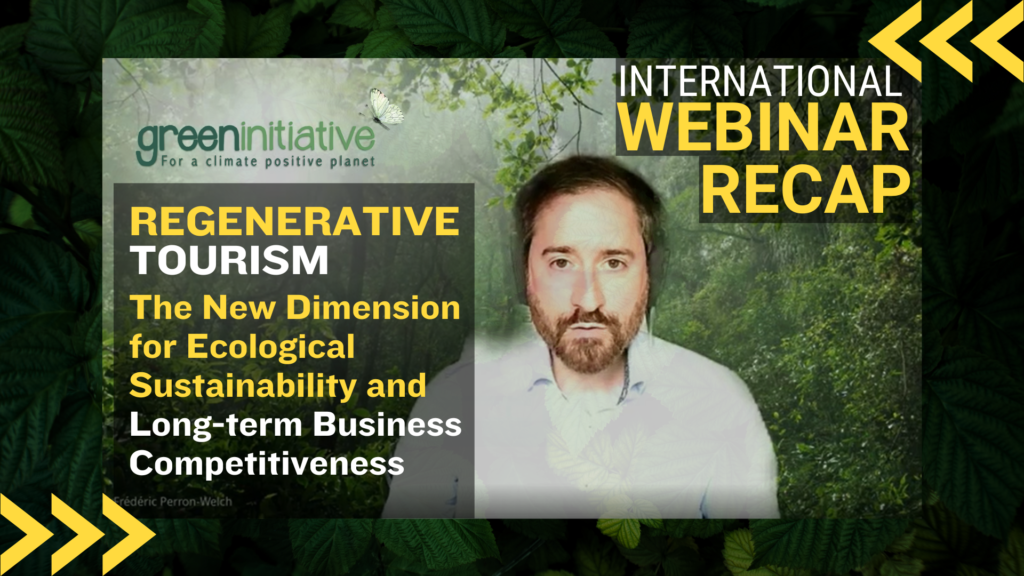
Recap - Webinar on Regenerative Tourism: The Key Dimension for Ecological Sustainability and Business Competitiveness

Recap – Webinar on Regenerative Tourism: The Key Dimension for Ecological Sustainability and Business Competitiveness

On August 28, 2024, the Green Initiative hosted an exceptional international webinar titled “Regenerative Tourism: The New Dimension for Ecological Sustainability and Long-Term Business Competitiveness.” The event brought together a diverse group of experts, industry professionals, and global stakeholders to discuss the transformative potential of regenerative tourism. The webinar provided attendees with invaluable insights into how regenerative tourism practices are not only reshaping the future of travel but also contributing to global sustainability goals. Frédéric Perron-Welch, Head of Climate and Nature Policy at Green Initiative, kicked off the webinar with a warm welcome. “Regenerative tourism is not just about sustainability; it’s about restoring and enhancing the ecosystems and communities that make tourism possible,” said Perron-Welch, emphasizing the core philosophy of the event. Keynote Presentations Marcos Vaena – Senior Executive at IFC Marcos Vaena provided a comprehensive overview of the International Finance Corporation’s (IFC) Environmental and Social Performance Standards, illustrating how they align with the principles of regenerative tourism. He highlighted the synergies between green finance and regenerative practices, particularly in emerging markets. “In today’s world, going beyond sustainability is crucial for destinations that want to differentiate themselves in a competitive marketplace. Regenerative tourism offers a blueprint for long-term success by ensuring that tourism projects do not adversely impact the natural assets that these countries possess,” Vaena stated. He also discussed how IFC’s performance standards, which include guidelines on labor conditions, community health, and biodiversity conservation, are critical in boosting competitiveness in the tourism sector. Virginia Fernandez-Trapa – Programme Coordinator, UN World Tourism Organization Virginia Fernandez-Trapa presented a compelling discussion on the “Regenerate Pathway” of The Glasgow Declaration. She emphasized that concept challenges conventional tourism practices by focusing on not only preserving but actively restoring ecosystems. “The regenerate pathway challenges us to go beyond conventional practices, focusing on restoring ecosystems and supporting nature’s ability to draw down carbon”, said Fernandez-Trapa She highlighted how the regenerate pathway is central to the goals of the Glasgow Declaration and emphasized the need for a balanced approach that incorporates environmental, social, and economic pillars of sustainable development. “At present and in alignment with the Glasgow Declaration pathways for us is clear, that regenerative can certainly play a role in accelerating the pace of change towards the needed balance, so that we can ultimately ensure sustainable development of our societies, and we need to integrate those regenerative arteries and policies and actions”, she added. Tenisha Brown-Williams – Senior Tourism Specialist, Inter-American Development Bank Tenisha Brown-Williams captivated the audience with compelling case studies from Barbados and Brazil, showcasing how regenerative tourism can lead to transformative change. She shared the story of Walker’s Reserve in Barbados, a former quarry transformed into a thriving ecotourism destination, and the IDB‘s Salvador program in Brazil, which empowers Afro-Brazilian communities through regenerative tourism. “I want to bring us all to one common point of agreement. We can all agree that in spite of the debates around sustainable turism and regenerative…. I think we could agree that given the climate crisis and other pressing vulnerabilities the global tourism industry must embrace in a new approach, so it is imperative for all stakeholders within the tourism value chain to adopt, what is called a transformative mindset, and this shift really involves moving beyond purely economic objectives to embrace the holistic reflections, which I have highlighted… On some rhetorical questions, we need to ponder: it’s tourism a benefit to the people at the destination or to the tourists?, said Brown-Williams. “I want to propose that a mind cannot be transformed without visible proof of change and tangible evidence of its impact. So the IDB’S Tourism sector framework has a line of action which deals with original knowledge agenda for the tourism sector that covers important issues for which there is a lack of information. We also need to continue to inspire by sharing examples which strengthen community based tourism enterprises such as the examples shared in Belize, the Bahamas and Dominica, with elements of regenerative tourism at it’s core”, she added. “I propose that the future of regenerative tourism hinges on our collective recognition that it is a mindset shift, brought to life through strategic policies and programs, and fully realized through robust partnerships across the entire tourism value chain. It is in this unified understanding and collaborative effort that we will shape a truly regenerated future for the global tourism industry. As we face unprecedented challenges, regenerative tourism offers a path forward that benefits both people and the planet. By fostering inclusive, community-driven initiatives, we can ensure that tourism serves as a powerful tool for positive change and long-term resilience,” she concluded. In closing, Tenisha Brown-Williams emphasized the critical importance of regenerative tourism as a transformative force within the industry. She called on all stakeholders to embrace this new approach, which prioritizes not only environmental sustainability but also social equity and cultural preservation. Inspiring Case Studies Gabriel Meseth – Project Manager, Inkaterra Hotels Gabriel Meseth presented Inkaterra’s pioneering efforts in ecotourism and sustainable development in Peru, focusing on their initiatives in the Amazon rainforest and the Machu Picchu cloud forest. He highlighted the successful restoration of these areas and the innovative waste management strategies that have made Machu Picchu the first carbon-neutral UNESCO Designated Site. “Inkaterra’s approach to regenerative tourism is deeply rooted in scientific research and community engagement. By restoring ecosystems and empowering local communities, we are not only preserving Peru’s natural heritage but also setting new standards for sustainable tourism worldwide,” Meseth explained. He also discussed the importance of public-private partnerships in achieving these ambitious goals, citing the collaboration between Inkaterra, the Green Initiative, and local communities as a model for other regions. André Fortunato – Program Manager, CEPA (Customized Educational Programs Abroad) André Fortunato shared CEPA’s innovative approach to regenerative tourism through their study abroad programs in Costa Rica and Guatemala. He emphasized the importance of service learning and climate-positive actions in educating students and supporting local communities. “Through our programs, students not only learn about sustainability but actively contribute


Recap – Webinar on Regenerative Tourism: The Key Dimension for Ecological Sustainability and Business Competitiveness Read More »

Charting a Course Towards Sustainable and Resilient Prosperity in Fisheries and Aquaculture

Charting a Course Towards Sustainable and Resilient Prosperity in Fisheries and Aquaculture

The resilience and prosperity of the region’s small-scale fisheries are crucial, as they are the main source of livelihood for fishers in the sector. The recent impact of Hurricane Beryl on Grenada, Saint Vincent and the Grenadines, Jamaica, and Barbados has highlighted the urgent need to protect and modernize this critical sector. The storm, a clear indication of climate change, has shown the potential devastation that rapidly forming hurricanes can bring to communities and livelihoods. In response to these challenges, the Caribbean Regional Fisheries Mechanism (CRFM) is promoting sustainable fishery practices and resilience. Its initiatives, which include decarbonizing the sector, enhancing marine habitat restoration, and securing financial resources for adaptation and mitigation, are crucial. However, international support is also needed to ensure a resilient future for the region’s fisheries and aquaculture industries. Read the full article here. Useful reports here.

Charting a Course Towards Sustainable and Resilient Prosperity in Fisheries and Aquaculture Read More »

The Role Of Satellite Data And Analytics In Monitoring The Restoration Of Degraded Forests - Green Initiative

The Role Of Satellite Data And Analytics In Monitoring The Restoration Of Degraded Forests

The more forests we lose every year, the more we recognize their importance in different industries and daily routines. Awakened by the threat of climate change and alarming forest loss, modern businesses that are in any way connected to forestry start recognizing the need for related mitigation activities. The umbrella term for them is forest restoration — a crucial initiative aimed at reviving degraded ecosystems, enhancing biodiversity, and increasing resilience to climate change. The process involves replanting native trees to restore soil health and revitalize habitats for wildlife. Luckily, there is an innovative technology to help with all this. This article focuses on satellite data analytics — an invaluable tool in restoration efforts. By offering a comprehensive view of forest conditions and changes, free high-resolution satellite imagery allows for more precise and effective restoration strategies, paving the way for a healthier and more resilient planet. But before we jump into more details, let’s discuss why it’s even important. Why Care About Forest Ecosystems It’s common knowledge that trees are pillars holding the Earth’s environmental balance by acting as carbon sinks and absorbing vast amounts of carbon dioxide from the atmosphere. But, as we’ve mentioned in the beginning, their role stretches beyond that. Forests also regulate water cycles, maintain soil health, and provide habitat for a multitude of species. And it works both ways. For example, healthy soil supports tree growth — tree roots support soil health. However, deforestation and forest degradation, driven by logging, agriculture, urban expansion, and aridification have led to significant losses of forest cover globally. Restoring these forest is essential to sustaining ecosystem services and ensuring ecological stability. Satellite Data and Analytics in Forest Monitoring There is no doubt that technology has become a powerful ally in the realm of forest conservation and restoration. One of the most transformative advancements is the use of satellite data and analytics in forest monitoring. With the ability to get access to high-resolution satellite images, scientists and environmentalists can now observe and analyze vast expanses of forest in unprecedented detail. Such an approach not only enhances our understanding of forest dynamics but also provides critical insights for effective management and conservation strategies. By harnessing the power of satellite tech, we can better protect our precious green landscapes and ensure their health and sustainability for future generations. Let’s see how it works for exact purposes. Deforestation Detection By leveraging advanced satellite technologies, we can monitor vast forested areas with remarkable precision and timeliness. This method allows for the detection of deforestation events in near real-time, identifying even subtle changes in forest cover that might go unnoticed be it any other way of observation. High-resolution satellite images provide detailed visual data, enabling researchers to pinpoint the exact locations and extent of forest loss. This kind of knowledge is vital for policymakers and conservationists, enabling them to respond swiftly and effectively to illegal logging activities, desertification, and other threats to forest ecosystems. Monitoring Reforestation Projects For the reforestation to be effective, there has to be proper forest management: one that caters to specific goals, such as recovery from deforestation, harvesting, or wildfires. The choice of trees varies with these goals: some species excel in carbon absorption, while others grow quickly. Restoring ecosystems depends on planting diverse species. Monoculture forests are vulnerable to disease, whereas polyculture forests enhance biodiversity and resilience. Techniques like clearcuts or prescribed fires can accelerate natural restoration. Remote sensing simplifies reforestation management, especially in inaccessible areas. High-resolution satellite imagery provides early insights into progress and detects problems promptly. Vegetation indices help foresters identify and address unhealthy areas, ensuring successful reforestation. Assessing Forest Health A powerful tool here is utilizing vegetation indices, such as the Normalized Difference Vegetation Index (NDVI). This way researchers can evaluate the vitality of forests with remarkable accuracy. NDVI values, derived from high-quality satellite images, depict the difference between visible and near-infrared light reflected by vegetation, providing insights into plant health, biomass, and productivity. These indices highlight areas of vegetation stress or disease, allowing for early detection of issues that could escalate into significant problems. Satellite imagery enables continuous monitoring over large areas, ensuring that even remote or inaccessible forests are included in health assessments. This technology equips environmentalists and policymakers with the data needed to make informed decisions, implement timely interventions, and develop strategies for sustainable forest management. Carbon Sequestration Measurement By utilizing satellite data, experts can accurately estimate the carbon content stored in forests through detailed measurements of tree biomass and growth rates. This advanced technology enables them to quantify the impact of restoration projects on mitigating climate change, providing valuable insights into how effectively these efforts are reducing atmospheric carbon levels. Through such precise monitoring, we can better understand and enhance the role of forests in our global climate strategy. Planning And Tracking Afforestation To ensure successful afforestation and sustainable forest plantations, precise monitoring is key. This is achieved by using data from various satellites like Sentinel-1 and Sentinel-2, and the power of machine learning to compile bi-weekly forest cover data. Choosing the right tree species is also crucial. Analyzing local forest inventories helps select species that thrive, ensuring a positive impact on the ecosystem. Historical satellite imagery can help track regrowth, and combined with spatial analysis, provides a comprehensive view of forest dynamics. This aids in managing tree loss and replanting efforts quite effectively. Benefits of Remote Sensing Remote sensing offers numerous benefits for forest monitoring. It provides an enhanced spatial representation of the monitored area and covers large geographical regions systematically. Non-intrusive and systematic data collection methods ensure minimal disruption to the environment. Increased data frequency allows for more accurate observations, enabling rapid decision-making. Additionally, remote sensing can acquire information in challenging or inaccessible areas, potentially reducing the costs of monitoring programs. At Green Initiative, we utilize high-resolution satellite data for various applications. Over longer periods (e.g. above 3 years) we monitor the abundance of vegetation in our restoration sites by measuring the change in NDVI over time. The results of these

The Role Of Satellite Data And Analytics In Monitoring The Restoration Of Degraded Forests Read More »

The European Union's Nature Restoration Law A Model for Global Restoration Efforts - Green Initiative

The European Union’s Nature Restoration Law: A Model for Global Restoration Efforts?

In a groundbreaking effort to tackle the dual crises of biodiversity loss and climate change, the European Union has adopted the Regulation on Nature Restoration. This new legislative framework is a pivotal component of the European Green Deal and the EU Biodiversity Strategy for 2030, aiming to restore degraded ecosystems across the continent, enhance biodiversity, and strengthen climate resilience. Background and Objectives The Regulation responds to the urgent need to restore Europe’s natural habitats, which are in a state of decline due to various human activities, including intensive agriculture, urbanization, pollution, and climate change. It builds on existing conservation efforts under the EU Habitats Directive and the Birds Directive, expanding their scope and introducing legally binding restoration targets. Furthermore, the EU Regulation on Nature Restoration aligns seamlessly with the UN Decade on Ecosystem Restoration (2021-2030), a global initiative aimed at preventing, halting, and reversing the degradation of ecosystems worldwide. This UN initiative underscores the critical importance of large-scale restoration efforts in addressing biodiversity loss and climate change, themes that are echoed in the EU’s ambitious targets. This alignment not only reinforces the global urgency for ecosystem restoration but also positions the EU as a leader in driving international efforts towards a more sustainable and resilient future. Key Provisions The Regulation sets ambitious targets to restore degraded terrestrial, inland water, coastal, and marine ecosystems. By 2030, at least 30% of these ecosystems are to be under restoration, with a long-term goal of covering all ecosystems in need of restoration by 2050. Specific targets include: EU Member States must develop and implement national restoration plans, based on scientific evidence, that include measures to improve the condition of habitats and species listed in the Habitats and Birds Directives. Restoration measures should ensure continuous improvement until favorable conservation status is achieved. In addition, the Regulation highlights the link between biodiversity and climate change with restoration projects aimed at contributing to climate change mitigation and adaptation, enhancing natural carbon sinks and increasing ecosystem resilience. Synergy with the European Climate Law is crucial, particularly its aim for climate neutrality by 2050. Special attention is given to marine habitats, with specific restoration actions mandated for marine species and habitats in alignment with the Marine Strategy Framework Directive. Member States must report on their progress towards the restoration targets, using standardized indicators and methodologies. The European Environment Agency (EEA) will play a key role in supporting these efforts, ensuring transparency and accountability. The Regulation provides for financial support from various EU funding mechanisms, including the Common Agricultural Policy (CAP), the LIFE Programme, and the European Maritime and Fisheries Fund (EMFF). Incentives for private land conservation and sustainable management practices are also included. Challenges and Opportunities Implementing the Regulation will face several challenges. Adequate funding and technical expertise are essential for the success of restoration projects and technical and financial resources will need to be mobilized at scale to achieve the targets established. In addition, effective collaboration with local communities, farmers, foresters, and other stakeholders will be critical for success as implementation must reconcile ecological restoration with socio-economic activities, ensuring that restoration efforts do not unduly disrupt livelihoods. Yet, the opportunities are significant. Restored ecosystems can provide numerous benefits, including improved air and water quality, enhanced biodiversity, climate regulation, and increased resilience against natural disasters, and the restoration economy can create high-quality jobs and stimulate sustainable growth that lasts. Conclusion The EU Regulation on Nature Restoration represents a landmark step towards a sustainable future. By setting ambitious, legally binding targets for ecosystem restoration, the Regulation aims to reverse biodiversity loss, enhance climate resilience, and promote a healthier environment. Successful implementation will require concerted efforts from all Member States, robust scientific support, and active stakeholder participation. EU member states must begin planning to submit national restoration plans to the Commission, providing details on how they will deliver on the targets and monitor and report on their progress based on EU-wide biodiversity indicators. The adoption of the Regulation reaffirms that environmental sustainability remains a top priority for the EU despite recent electoral results, meaning that companies remain compelled to adopt sustainable business practices that minimize their environmental footprint and are nature positive. This adds to the heightened accountability companies now face, including from the perspective of financial disclosures on nature-related risks. Implementation across EU Member States will impact business operations significantly and will require companies to prepare to align their activities with evolving national regulations, which may mean adjusting current practices to comply with emerging standards. This signals a pivotal moment for EU businesses, which must plan ahead to adapt and innovate within a stricter environmental framework. Written by Frédéric Perron-Welch, from the Green Initiative team.

The European Union’s Nature Restoration Law: A Model for Global Restoration Efforts? Read More »